2017-09-06 Wed
■ #3054. 黒死病による社会の流動化と諸方言の水平化 [black_death][reestablishment_of_english][history][demography][me_dialect][sociolinguistics][dialect_levelling]
英語史では中世における英語の復権と関連して,たいてい黒死病のことが触れられる.しかし,簡単に言及されるにとどまり,突っ込んだ説明のないものも多い.そのなかで,一般向けの英語史読本を著わした Gooden (67--68) は,黒死病に対して1節を割くほどの関心を示している.読み物としておもしろいので引用しておこう.なお,引用の第2段落の1部は,Black Death の語源と関連して「#2990. Black Death」 ([2017-07-04-1]) でも取りあげた.
The Black Death had a devastating effect on the British Isles, as on the rest of Europe. The population of England was cut by anything between a third and a half. Probably originating in Asia, the plague arrived in a Dorset port in the West country in 1348, rapidly spreading to Bristol and then to Gloucester, Oxford and London. If a rate of progress were to be allotted to the plague, it was advancing at about one-and-a-half miles a day. The major population centres, linked by trading routes, were the most obviously vulnerable but the epidemic had reached even the remotest areas of western Ireland by the end of the next decade. Symptoms such as swellings (the lumps or buboes that characterize bubonic plague), fever and delirium were almost invariably followed within a few days by death. Ignorance of its cause heightened panic and public fatalism, as well as hampering effectual preventive measures. Although the epidemic petered out in the short term, the disease did not go away, recurring in localized attacks and then major outbreaks during the 17th century which particularly affected London. One of them disrupted the preparations for the coronation of James I in 1603; the last major epidemic killed 70,000 Londoners in 1665.
The term 'Black Death' came into use after the Middle Ages. It was so called either because of the black lumps or because in the Latin phrase atra mors, which means 'terrible death', atra can also carry the sense of 'black'. To the unfortunate victims, it was the plague, or, more often, the pestilence. So Geoffrey Chaucer calls it in The Pardoner's Tale, where he makes it synonymous with death. The words survive in modern English even if with a much diminished force in colloquial use: 'He's a pest.' 'Stop plaguing us!' Curiously, although pest in the sense of 'nuisance' has its roots in pestilence, the word pester comes from a quite different source, the Old French empêtrer ('entangle', 'get in the way of').
The impact of the pestilence on English society was profound. Quite apart from the psychological effects, there were practical consequences. Labour shortages meant a rise in wages and more fluid social structure in which the old feudal bonds began to break down. Geographical mobility would also have helped in dissolving regional distinctions and dialect differences.
黒死病による人口減少により,生き残った労働者の賃金が上がり,彼らの社会的地位が上昇するとともに彼らの母語である英語の社会的地位も上昇した,というのが黒死病の英語史上のインパクトと言われる.しかし,引用の最後にあるように,人々が社会的にも地理的にも流動化したという点にも注目すべきである.これにより,人々がますます混交し,とりわけロンドンのような都会では諸方言が水平化してゆく契機となった (cf. dialect levelling) .黒死病は,確かに英語の行く末に間接的な影響を与えたといえるだろう.
・ Gooden, Philip. The Story of English: How the English Language Conquered the World. London: Quercus, 2009.
2016-10-31 Mon
■ #2744. 大母音推移の社会音韻論的考察 (3) [gvs][sociolinguistics][meosl][me_dialect][contact][vowel][phonetics]
「#2714. 大母音推移の社会音韻論的考察」 ([2016-10-01-1]),「#2724. 大母音推移の社会音韻論的考察 (2)」 ([2016-10-11-1]) に続き,第3弾.第2弾の記事 ([2016-10-11-1]) で,System II の母音体系をもっていたとされる多くの南部・中部方言話者が,権威ある System I のほうへ過剰適応 (hyperadaptation) したことが大母音推移 (gvs) の引き金となった,との説を紹介した.しかし,Smith (106--07) によると,もう1つ GVS の引き金となった母音体系をもった話者集団がいたという.それは,"Easterners" と呼ばれる,おそらく East Anglia 出身の人々である.
East Anglia では,14世紀後半から15世紀にかけてロンドンで進行し始めた大母音推移と類似する推移が,ずっと早くに生じていた.背景として,古英語の Saxon 方言の ǣ に対して Anglia 方言では ē をもっていたこと,/d, t, n, s, l, r/ の前位置で上げ (raising) を経ていたことなどがあった.この推移の結果として,East Anglia の母音体系は,3段階の高さで5つの長母音をもつ /iː, uː, eː, oː, aː/ となっていた.
さて,この Easterners が,15世紀の前半から半ばにかけて都市化の進むロンドンへ移住し,ロンドン英語,特に権威ある System I の話者と接触したときに,もう1つの過剰適応が引き起こされた.3段階の East Anglia の体系が,さらに細かく段階区分された System I と接触したとき,前者は後者の威信ある調音に引かれて,全体として調音位置の調整を迫られることになった.具体的には,Easterners は System I の [æː] を自分たちの /eː/ と知覚して後者として発音し,同様に [eː̝] を /iː/ と知覚して,そのように発音した.3段階しかもたない Easterners にとって,中英語の /eː/ をもつ語と /ɛː/ をもつ語の区別はつけられなかったので,結局いずれも /iː/ として知覚され,発音されることになった.およそ同じことが後舌系列の母音にも起こった.
System III というべき Easterners のこの母音体系は,実は,後に18世紀までに勢力を得て一般化し,現代標準英語の meed, mead, maid, made などに見られる一連の母音の(不)区別を生み出す母体となった.その点でも,英語母音史上,大きな役割を担った母音体系だったといえるだろう.
・ Smith, Jeremy J. An Historical Study of English: Function, Form and Change. London: Routledge, 1996.
2016-10-11 Tue
■ #2724. 大母音推移の社会音韻論的考察 (2) [gvs][sociolinguistics][chaucer][meosl][me_dialect][contact][vowel][diphthong]
「#2714. 大母音推移の社会音韻論的考察」 ([2016-10-01-1]) に引き続き,大母音推移 (gvs) という音韻論上の過程を社会言語学的な観点から説明しようとする試みについて考える.前の記事では1つの見方を概論的に紹介した程度だったが,諸家によって想定される母音の分布や関係する英語変種は若干異なっている.今回は,Smith (101--06) に従って,もう1つの社会音韻論的な説明を覗いてみよう.
Smith は,Chaucer の時代までにロンドンでは2つの異なる母音体系が並存していたと仮定している(Smith (102) からの下図を参照).System I は,Chaucer に代表される上層階級に属する人々のもっていた体系であり,前舌系列が5段階と複雑だが,社会的な威信をもっていたと考えられる.* の付された長母音は,対応する短母音が中英語開音節長化 (Middle English Open Syllable Lengthening; meosl) を経て若干位置を下げながら長化した音である.一方,System II は,それ以外の多くのイングランド南部・中部方言の話者がもっていた体系であり,前舌系列が4段階だったと想定されている.
| System I | System II | |||||||||||||||||
| iː | > | ɪi | uː | > | ʊu | iː | > | əɪ | uː | > | əʊ | |||||||
| eː | > | eː̝ | oː | > | oː̝ | eː | > | iː | oː | > | uː | |||||||
| ɛː̝* | ɔː̝* | ɛː | > | eː | ɔː | > | oː | |||||||||||
| ɛː | ɔː | aː* | > | ɛː, eː | ||||||||||||||
| aː* | > | æː | ||||||||||||||||
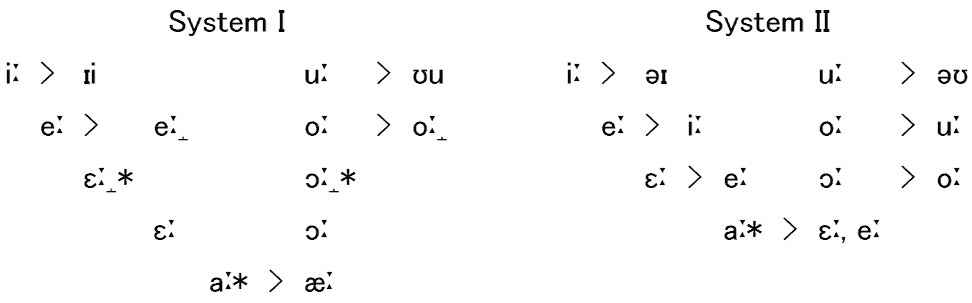
このような2つの体系が15世紀初頭のロンドンで接触したときに,結果として System II の話者が社会的上昇志向から System I の方向への「上げ」 (raising) を生じさせることになったのだという.
まず,System II 話者の [ɛː] について考えよう.System II 話者は,System I 話者の [ɛː] と [ɛː̝*] の各々がどの単語に現われるのか区別できないこと,及び System I 話者の [ɛː̝*] に現われるやや高い調音を模倣したいことから,全体として自らの [ɛː] を若干上げ,結果として [eː] と発音するに至る.
次に,System II 話者のもともとの [eː] は,System I 話者の [eː] のやや高い調音(おそらく System I 話者の慣れていたフランス語の緊張した調音の影響を受けたやや高めの異音)を過剰気味 (hyperadaptation) に模倣した結果,[iː] と発音するに至った.
最後に,System II 話者の [aː*] については,少々ややこしい事情があった.System II の [aː*] は a の開音節長化により生じた新しい音だったが,同時代の Essex 方言では古英語 [æː] の発展形としての [aː] が従来行なわれていた関係で,前者が後者と同一視されるに至った.そこで,ロンドンの話者は Essex 方言と同一視されるのを嫌い,社会言語学的な距離 (sociolinguistic distancing) をとるべく,やや上げて [æː] と調音するようになったのだという.その後,この音は17世紀後半に改めて別の上げを経て [eː] へと変化していった.
上記は決して単純な説ではないが,逆に言えば,一見きれいに見える大母音推移も,社会音韻論的に複雑な過程を内包しているということを思い起こさせてくれる説である.
・ Smith, Jeremy J. An Historical Study of English: Function, Form and Change. London: Routledge, 1996.
2016-09-29 Thu
■ #2712. 初期中英語の個性的な綴り手たち [eme][me_dialect][manuscript][orthography][spelling][standardisation][scribe][ormulum][ab_language][spelling_reform]
英語の綴字標準化の歴史は,後期ウェストサクソン方言で標準的なものが現われるが,ノルマン征服後の初期中英語にはそれが無に帰し,後期中英語になって徐々に再標準化の兆しが芽生え,初期近代英語期中に標準化が進み,17--18世紀に標準綴字が確立した,と大雑把に要約できる.この概観によれば,初期中英語期は綴字の標準がまるでなかった時代ということになる.それはそれで間違ってはいないが,綴字標準とはいわずとも,ある程度一貫した綴字慣習ということであれば,この時代にも個人や小集団のレベルで実践されていた形跡が少数見つかる.よく知られているのは,(1) "AB language" の綴字, (2) Ormulum の作者 Orm の綴字,(3) ブリテン史 Brut をアングロ・フレンチ版から翻訳した Laȝamon の綴字である.
(1) "AB language" の名前は,修道女のための指南書 Ancrene Wisse を含む Cambridge, Corpus Christi College 402 という写本 (= A) と,関連する聖女伝や宗教論を含む Oxford, Bodleian Library, Bodley 34 の写本 (=B) に由来する.この2写本(及び関連するいくつかの写本)には,かなり一貫した綴字体系が採用されており,しかも複数の写字生によってそれが用いられていることから,おそらく13世紀前半に,ある南西中部の修道院か写本室が中心となって,標準綴字を作り上げる試みがなされていたのだろうと推測されている.
(2) Orm は,Lincolnshire のアウグスティノ修道士で,1200年頃に,聖書を分かりやすく言い換えた書物 Ormulum を著わした.現存する唯一のテキストは2万行を超す韻文の大作であり,それが驚くほど一貫した綴字で書かれている.Orm は,母音の量にしたがって後続する子音を重ねるなどの合理性を追究した独特な綴字体系を編みだし,それを自分の作品で実践したのである.この Orm の綴字は,他の写本にも類するものが発見されておらず,きわめて個人的な綴字標準化の事例だが,これは後の16世紀の個性的な綴字改革論者の先駆けといってよい.
(3) Laȝamon は,Worcestershire の司祭で,13世紀初頭に韻文の年代記を韻文で英語へ翻訳した.当時すでに古めかしくなっていたとおぼしき頭韻 (alliteration) や,古風な語彙・綴字を復活させ,ノスタルジックな雰囲気をかもすことに成功した.Laȝamon は,実際に古英語にあった綴字かどうかは別として,いかにも古英語風な綴字を意識的に用いた点で特異であり,これをある種の個人的な綴字標準化の試みとみることも可能だろう.
以上,Horobin (98--102) を参照して執筆した.
・ Horobin, Simon. Does Spelling Matter? Oxford: OUP, 2013.
2016-06-07 Tue
■ #2598. 古ノルド語の影響力と伝播を探る研究において留意すべき中英語コーパスの抱える問題点 [old_norse][loan_word][me_dialect][representativeness][geography][lexical_diffusion][lexicology][methodology][laeme][corpus]
「#1917. numb」 ([2014-07-27-1]) の記事で,中英語における本来語 nimen と古ノルド語借用語 taken の競合について調査した Rynell の研究に触れた.一般に古ノルド語借用語が中英語期中いかにして英語諸方言に浸透していったかを論じる際には,時期の観点と地域方言の観点から考慮される.当然のことながら,言語項の浸透にはある程度の時間がかかるので,初期よりも後期のほうが浸透の度合いは顕著となるだろう.また,古ノルド語の影響は the Danelaw と呼ばれるイングランド北部・東部において最も強烈であり,イングランド南部・西部へは,その衝撃がいくぶん弱まりながら伝播していったと考えるのが自然である.
このように古ノルド語の言語的影響の強さについては,時期と地域方言の間に密接な相互関係があり,その分布は明確であるとされる.実際に「#818. イングランドに残る古ノルド語地名」 ([2011-07-24-1]) や「#1937. 連結形 -son による父称は古ノルド語由来」 ([2014-08-16-1]) に示した語の分布図は,きわめて明確な分布を示す.古英語本来語と古ノルド語借用語が競合するケースでは,一般に上記の分布が確認されることが多いようだ.Rynell (359) 曰く,"The Scn words so far dealt with have this in common that they prevail in the East Midlands, the North, and the North West Midlands, or in one or two of these districts, while their native synonyms hold the field in the South West Midlands and the South."
しかし,事情は一見するほど単純ではないことにも留意する必要がある.Rynell (359--60) は上の文に続けて,次のように但し書きを付け加えている.
This is obviously not tantamount to saying that the native words are wanting in the former parts of the country and, inversely, that the Scn words are all absent from the latter. Instead, the native words are by no means infrequent in the East Midlands, the North, and the North West Midlands, or at least in parts of these districts, and not a few Scn loan-words turn up in the South West Midlands and the South, particularly near the East Midland border in Essex, once the southernmost country of the Danelaw. Moreover, some Scn words seem to have been more generally accepted down there at a surprisingly early stage, in some cases even at the expense of their native equivalents.
加えて注意すべきは,現存する中英語テキストの分布が偏っている点である.言い方をかえれば,中英語コーパスが,時期と地域方言に関して代表性 (representativeness) を欠いているという問題だ.Rynell (358) によれば,
A survey of the entire material above collected, which suffers from the weakness that the texts from the North and the North (and Central) West Midlands are all comparatively late and those from the South West Midlands nearly all early, while the East Midland and Southern texts, particularly the former, represent various periods, shows that in a number of cases the Scn words do prevail in the East Midlands, the North, and the North (and sometimes Central) West Midlands and the South, exclusive of Chaucer's London . . . .
古ノルド語の言語的影響は,中英語の早い時期に北部・東部方言で,遅い時期には南部・西部方言で観察される,ということは概論として述べることはできるものの,それが中英語コーパスの時期・方言の分布と見事に一致している事実を見逃してはならない.つまり,上記の概論的分布は,たまたま現存するテキストの時間・空間的な分布と平行しているために,ことによると不当に強調されているかもしれないのだ.見えやすいものがますます見えやすくなり,見えにくいものが隠れたままにされる構造的な問題が,ここにある.
この問題は,古ノルド語の言語的影響にとどまらず,中英語期に北・東部から南・西部へ伝播した言語変化一般を観察する際にも関与する問題である (see 「#941. 中英語の言語変化はなぜ北から南へ伝播したのか」 ([2011-11-24-1]),「#1843. conservative radicalism」 ([2014-05-14-1])) .
関連して,初期中英語コーパス A Linguistic Atlas of Early Middle English (LAEME) の代表性について「#1262. The LAEME Corpus の代表性 (1)」 ([2012-10-10-1]),「#1263. The LAEME Corpus の代表性 (2)」 ([2012-10-11-1]) も参照.
・ Rynell, Alarik. The Rivalry of Scandinavian and Native Synonyms in Middle English Especially taken and nimen. Lund: Håkan Ohlssons, 1948.
2016-05-01 Sun
■ #2561. The Proclamation of Henry III [me][reestablishment_of_english][history][popular_passage][me_dialect][me_text]
ノルマン征服以来,初めて英語で発行された王による宣言書は1258年の Proclamation of Henry III である.これは,フランス語のくびきのもとにあった中世イングランドにあって,記念碑的な出来事だった.(実際には,もう1つ早い例外があり,1155年に Henry II がカンタベリ大司教らに与えた特許状がそれである).Henry III によるこの宣言書は,1258年に諸侯たちが王より獲得した Provisions of Oxford を確認するものであり,フランス語と,おそらくラテン語でも発行された.英語でも書かれることになったのは,Simon de Montfort が英語を話すことのできない者を根絶するよう王に要求し,圧力をかけたことと関係する.
この宣言書はイングランドとアイルランドのすべての州に配布されたようで,そのうち英語版としては2つのみ現存している.1つは Oxfordshire に送られたもので,もう1つは Huntingdon 宛てのものである.後者は,これが原本となってさらなる写しが作られたもののようだ.Huntingdon 宛てのこの写しは,13世紀という早い時期(現存する最古)のロンドン方言を表わしていると考えられ,英語史的にも価値が高い.本来ロンドン方言は南部的な要素が強かったが,14世紀までにはむしろ東中部的な特徴を主として示すようになっていた.この写しのテキストは,したがって,13世紀後半の両方言の混交の過程をまさに示しているという点で重要なのである.
以下に,Dickins and Wilson 版 (8--9) より,テキスト全文を掲げよう.
A Proclamation
Henri, þurȝ Godes fultume King on Engleneloande, Lhoauerd on Yrloande, Duk on Normandi, on Aquitaine, and Eorl on Aniow, send igretinge to alle hise holde, ilærde and ileawede, on Huntendoneschire. Þæt witen ȝe wel alle þæt we willen and vnnen þæt, þæt vre rædesmen alle, oþer þe moare dæl of heom, þæt beoþ ichosen þurȝ us and þurȝ þæt loandes folk on vre kuneriche, habbeþ idon and shullen don in þe worþnesse of Gode and on vre treowþe, for þe freme of þe loande þurȝ þe besiȝte of þan toforeniseide redesmen, beo stedefæst and ilestinde in alle þinge a buten ænde. And we hoaten alle vre treowe in þe treowþe þæt heo vs oȝen, þæt heo stedefæstliche healden and swerien to healden and to werien þo isetnesses þæt beon imakede and beon to makien, þurȝ þan toforeniseide rædesmen, oþer þurȝ þe moare dæl of heom, alswo alse hit is biforen iseid; and þæt æhc oþer helpe þæt for to done bi þan ilche oþe aȝenes alle men riȝt for to done and to foangen. And noan ne nime of loande ne of eȝte wherþurȝ þis besiȝte muȝe beon ilet oþer iwersed on onie wise. And ȝif oni oþer onie cumen her onȝenes, we willen and hoaten þæt alle vre treowe heom healden deadliche ifoan. And for þæt we willen þæt þis beo stedefæst and lestinde, we senden ȝew þis writ open, iseined wiþ vre seel, to halden amanges ȝew ine hord. Witnesse vsseluen æt Lundene þane eȝtetenþe day on þe monþe of Octobre, in þe two and fowertiȝþe ȝeare of vre cruninge. And þis wes idon ætforen vre isworene redesmen, Boneface Archebischop on Kanterburi, Walter of Cantelow, Bischop on Wirechestre, Simon of Muntfort, Eorl on Leirchestre, Richard of Clare, Eorl on Glowchestre and on Hurtford, Roger Bigod, Eorl on Northfolke and Marescal on Engleneloande, Perres of Sauueye, Willelm of Fort, Eorl on Aubemarle, Iohan of Plesseiz, Eorl on Warewik, Iohan Geffrees sune, Perres of Muntfort, Richard of Grey, Roger of Mortemer, Iames of Aldithele, and ætforen oþre inoȝe.
And al on þo ilche worden is isend into æurihce oþre shcire ouer al þære kuneriche on Engleneloande, and ek in-tel Irelonde.
・ Dickins, Bruce and R. M. Wilson, eds. Early Middle English Texts. London: Bowes, 1951.
2016-03-22 Tue
■ #2521. 初期中英語の113種類の "such" の異綴字 [spelling][eme][laeme][corpus][scribe][me_dialect][representativeness]
昨日の記事「#2520. 後期中英語の134種類の "such" の異綴字」 ([2016-03-21-1]) に続き,今回は初期中英語コーパス LAEME で "such" の異綴字を取り出してみたい (see 「#1262. The LAEME Corpus の代表性 (1)」 ([2012-10-10-1])) .この語は,初期中英語では形容詞,副詞,接続詞として用いられ,形容詞の場合には屈折もするので,全体として様々な形態が現われる.アルファベット順に一覧しよう(かっこ内の数値は文証される頻度).
hsƿucche (1), schilke (1), schuc (3), scli (1), scuche (1), sec (1), secc (1), secche (1), sech (2), seche (1), selk (1), selke (1), shuc (1), shuch (1), siche (1), silc (1), silk (3), sli (1), slic (5), sliik (1), slik (3), slike (1), slk (1), sly (1), soch (5), soche (1), solchere (1), suc (2), sucche (2), such (51), suche (1), suecche (1), suech (1), sueche (1), sueh (1), sug (1), suic (1), suicchne (1), suich (12), suiche (3), suilc (14), suilce (1), suilch (1), suilk (1), suilke (2), sulch (1), sulche (1), sulk (1), sulke (1), suuche (1), suweche (1), suwilk (1), suyc (1), suych (4), suyche (1), svich (2), sƿche (1), sƿic (3), sƿicche (1), sƿich (1), sƿiche (14), sƿichne (1), sƿilc (30), sƿilch (22), sƿilche (1), sƿilcne (1), sƿilk (14), sƿillc (10), sƿillke (2), sƿi~lch (1), sƿlche (1), sƿuc (4), sƿucch (1), sƿucche (4), sƿucches (1), sƿuch (1), sƿuche (1), sƿuchne (1), sƿuilc (1), sƿulc (8), sƿulce (1), sƿulche (9), swch (1), swecche (1), swech (1), sweche (2), swich (5), swiche (1), swics (1), swil (1), swilc (5), swilce (1), swilk (2), swilke (2), swilkee (2), swlc (1), swlch (1), swlche (1), swlchere (1), swlcne (1), swuche (2), swuh (1), swulcere (1), swulch (3), swulchen (1), swulchere (1), swulke (1), swulne (1), zuich (10), zuiche (14), zuichen (3), zuych (10), zuyche (2)
大文字と小文字の区別はつけずに,合計113種類の綴字が文証される.そのなかで頻度にしてトップ5の綴字を抜き出すと,such, sƿilc, sƿilch, sƿilk, sƿiche となり,この5種類だけで全用例369個のうち131個 (35.5%) を占める.
昨日の後期中英語からの134種類と合わせ,重複綴字を減算すると,中英語全体として247種類の異綴字があることになる.使用した方言地図やコーパスも必ずしも網羅的ではないので,これは控えめな数値と思われる.例えば,MED の swich (adj.) に掲げられている異綴字を加えれば,種類はもう少し増えるだろう.
2016-03-21 Mon
■ #2520. 後期中英語の134種類の "such" の異綴字 [spelling][lme][lalme][corpus][scribe][me_dialect][frequency]
「#53. 後期中英語期の through の綴りは515通り」 ([2009-06-20-1]),「#219. eyes を表す172通りの綴字」 ([2009-12-02-1]) に引き続き,英語史における著しい綴字の変異について.今回は,異綴字の種類の多さに定評のある(?) "such" を取り上げる.
「#1622. eLALME」 ([2013-10-05-1]) で紹介した,後期中英語の方言地図 LALME の改訂・電子版 eLALME において,Item List 10 が "such" を扱っている.この一覧から異綴字を抜き出すと,不確かな例を除いて少な目に数えても,以下の134種類が挙がる(かっこ内の数値は文証される頻度).
asoche (1), aswyche (1), schch (1), schech (1), scheche (3), schiche (1), schoche (1), scht (1), schuc (1), schuch (3), schuche (4), schut (1), schute (1), sclik (2), sclike (1), sclyk (2), sclyke (2), scoche (1), scwche (1), sech (8), seche (39), sewyche (2), shich (1), shiche (1), shoch (1), shoche (1), shuch (5), shuche (3), shych (1), sic (6), sic- (1), sich (53), siche (101), sick (1), sɩͨh (1), sik (1), sik- (1), sike (2), silk (3), sli (1), slieke (1), slik (10), slike (26), slilk (2), slkyke (1), slyk (13), slyke (26), soch (12), soche (60), souche (3), sowche (2), soyche (1), squike (1), squilk (2), squylk (1), sqwych (1), sqwyche (1), sswiche (1), suc (1), succh (1), sucche (5), such (242), suche (375), suchee (1), sucheȝ (1), suchet (1), sucht (1), suchte (1), suech (4), sueche (6), suhc (1), suhe (1), suich (9), suiche (7), suilk (6), suilk- (1), suilke (3), suilkin (1), sulc (1), sulk (4), sulke (2), sutche (1), suth (1), suuch (1), suuche (1), suuech (1), suueche (1), suych (13), suyche (15), suylk (7), suylke (6), svche (1), sviche (1), swc (1), swch (7), swche (4), swech (19), sweche (48), swelk (4), swhiche (2), swhilke (2), swhych (2), swhyche (1), swic (2), swich (77), swiche (84), swichee (1), swilc (3), swilk (76), swilke (45), swilkes (1), swisɩͨhe (1), swlk (1), swlke (1), swuch (3), swuche (2), swych (56), swyche (65), swyeche (1), swyk (1), swyke (1), swyl (1), swylk (62), swylke (35), swylle (1), syc- (1), sych (23), syche (67), syge (1), syk (4), syk- (1), syke (5), sylk (3), sylke (2)
方言の別を度外視して頻度の統計を取ると,トップ10が suche, such, siche, swiche, swich, swilk, syche, swyche, swylk, soche である.トップの2種類 suche と such は現代英語を見慣れている者にとって,十分常識的にみえるだろう.実際,この2種類だけで617例が文証され,総1867例のほぼ3分の1を占める.また,トップの10種類だけで,ほぼ3分の2を占める.したがって,異綴字がこれだけ多くあるからといって,そのまま完全なる混沌に等しい,ということにはならない.このような事情は,中英語期に多種類の綴字が認められる多くの語について認められ,混沌のなかにもある程度の秩序らしきものがが宿っているといえる.そうだとしても,当時の書き手と読み手にとってはやはり不便な状況だったに違いない.この点については,「#1311. 綴字の標準化はなぜ必要か」 ([2012-11-28-1]),「#1450. 中英語の綴字の多様性はやはり不便である」 ([2013-04-16-1]) で論じた通りである.
初期中英語や近現代の諸方言形を調べれば,もっと異綴字の種類は増すだろう.出典は失念したが,数え方にもよるものの,500種類ほどという数字を見かけたことがある・・・.
2015-10-18 Sun
■ #2365. ノルマン征服後の英語人名の姓の採用 [onomastics][personal_name][geolinguistics][geography][me_dialect][by-name]
昨日の記事「#2364. ノルマン征服後の英語人名のフランス語かぶれ」 ([2015-10-17-1]) で触れた通り,イングランドで名 (first name) に加えて姓 (surname) を採用するようになったのは,概ねノルマン征服以降であり,採用の順序も社会的身分の高い者から低い者にかけてであった.13--14世紀にかけて一般に拡がったようだが,地域差もあり,北部は南部よりも遅かった.Coates (327--28) の説明を引用する.
Surnames came into use among the Norman aristocracy shortly before the Conquest. The practice was neither universal nor stable then or in the early period of Norman rule in England, though by about 1250 it was the norm in the highest social class and the knightly and other taxpaying classes. Between 1300 and 1400 the practice had spread to the urban moneyed classes, though it appears that in some towns, such as York, the lower classes might be without surnames till as late as 1600. Rural small free tenants, for whom evidence is more scant, began to acquire surnames before 1300 in the south, and the practice moved northwards, with new surnames still being formed in Lancashire as late as the sixteenth and seventeenth centuries; and this development is mirrored by that of the servile class. The adoption of surnames did not happen overnight anywhere, and our knowledge of the process is hindered by the different degrees to which social classes are represented in the record. . . / Surnames are distinguishing names given to people bearing the same personal name, and many of these came to be inherited, though the system is not in fully complete operation everywhere till the 1600s. Those which have been inherited were of course the ones originally bestowed on males, for a complex of reasons involving unambiguous identification of the rightful heir.
イングランド内で完全に制度化するまでには,近代を待たなければならないほど,姓の慣習はゆっくりと広まっていったことになる.方言差という問題に関しては,中英語における多くの言語変化が北部から南部へという方向を示すのに対し,言語慣習の変化と呼ぶべき姓の採用がむしろ南部から北部へと拡がったというのがおもしろい.
言語的革新の伝播がしばしば北から南へという方向を示したことについては,「#941. 中英語の言語変化はなぜ北から南へ伝播したのか」 ([2011-11-24-1]),「#1843. conservative radicalism」 ([2014-05-14-1]),「#1902. 綴字の標準化における時間上,空間上の皮肉」 ([2014-07-12-1]) を参照されたい.
・ Coates, Richard. "Names." Chapter 6 of A History of the English Language. Ed. Richard Hogg and David Denison. Cambridge: CUP, 2006. 312--51.
2015-09-06 Sun
■ #2323 中英語の方言ごとの主要作品 [me][literature][me_dialect][dialect]
古英語の主要作品とその方言分布・年代について「#1433. 10世紀以前の古英語テキストの分布」 ([2013-03-30-1]) で一覧した.中英語の作品については,「#1044. 中英語作品,Chaucer,Shakespeare,聖書の略記一覧」 ([2012-03-06-1]) で名前の略号とともに列挙したのみで,方言分布などを示していなかった.
今回は,中英語の主要作品について,宇賀治 (57--59) による一覧を掲げよう.制作年は原則として Kurath et al. (1954) によるものだが,OED を参照したものもあるとのこと.中英語方言文学のおともに.
| 1. 南東方言 | |
|---|---|
| c1275 | Kentish Sermons |
| 1340 | Dan Michel's Ayenbite of Inwyt (= D.M.'s Remorse of conscience) |
| 2. 南西方言 | |
| ?a1200 | Ancrene Wisse (Corp-C) (= The English Text of the Ancrene Riwle (= Nuns' Rule)) |
| ?a1200 | Laȝamon's Brute, or Chronicle of Britain |
| ?c1200 | Sawles Warde (= Soul's Guardian) |
| a1225--a1300 | Poema Morale (= Moral Ode) |
| ?c1225 | King Horn |
| c1250 | Floriz and Blauncheflur |
| c1250 | The Owl and the Nightingale |
| a1376--?a1387 | William Langland, Piers Plowman A-, B-, C-Versions |
| a1387 | John de Trevisa's Translation of Higden's Polychronicon (= H.'s History of many Ages) |
| 3. 東中部方言 | |
| a1121--1160 | The Peterborough Chronicle |
| ?c1200 | The Ormulum |
| a1250 | Bestiary |
| c1250 | The Story of Genesis and Exodus |
| 1258 | Proclamation of Henry III |
| c1300 | Havelock the Dane |
| 1382; 1388 | Wycliffite Bible |
| c1375--a1400 | Geoffrey Chaucer, The Canterbury Tales |
| a1393 | John Gower, Confessio Amantis |
| c1400 | Mandeville's Travels (Tit) |
| 1425--1520 | Paston Letters and Papers |
| a1438 | The Book of Margery Kempe |
| 4. 西中部方言 | |
| ?c1380 | Patience |
| ?c1380 | Pearl |
| ?c1390 | Sir Gawain and the Green Knight |
| 5. 北部方言 | |
| a1325 | Cursor Mundi (= The Runner of the World) |
| ?c1343--?a1349 | Richard Rolle, Prose and Verse |
| ?a1400 | Morte Arthure or The Death of Arthur |
・ 宇賀治 正朋 『英語史』 開拓社,2000年.
2015-06-22 Mon
■ #2247. 中英語の中部・北部方言で語頭摩擦音有声化が起こらなかった理由 (3) [phonetics][consonant][me_dialect][old_norse]
##2219,2220,2226,2238,2247 の記事で扱ってきた "Southern Voicing" に関する話題.
・ 「#2219. vane, vat, vixen」 ([2015-05-25-1])
・ 「#2220. 中英語の中部・北部方言で語頭摩擦音有声化が起こらなかった理由」 ([2015-05-26-1])
・ 「#2226. 中英語の南部方言で語頭摩擦音有声化が起こった理由」 ([2015-06-01-1])
・ 「#2238. 中英語の中部・北部方言で語頭摩擦音有声化が起こらなかった理由 (2)」 ([2015-06-13-1])
[2015-05-26-1]の記事で触れた Poussa の論文を読んでみた.中部・北部の Danelaw 地域に語頭 [f] の有声化が生じなかった,あるいはその効果が伝播しなかった理由を議論する上では,同地域に当初から [v] が不在だったこと,あるいは少なくとも一般的ではなかったことが前提とされる.しかし,Poussa (298) はこの前提を事実としては示しておらず,あくまで推論として提示しているにすぎない.この点,注意が必要である.
According to Skautrup (1944: 124), the sound system of Runic Danish had labial fricatives, voiced and unvoiced, and did not yet contain the labio-dental [f] and [v], but he believes that /f/ appeared in the following period. The development of the English dialects of the north midlands may have followed a similar time-table. The Runic Danish period corresponds to the period of Viking settlement in England, which was strongest in the north midlands. In the Eastern Division Viking Period settlement mainly affected East Anglia (particularly Norfolk) and part of Essex, which fell within the Danelaw in the late 9th. century. Southern Voicing of OE /f/ in initial position would have been unlikely in East Anglia, therefore, though during the OE/ME period initial [v] should have occurred in the Kentish dialect through the application of the Southern Voicing rule. [Skautrup = Skautrup, P. Det Danske Sprogs Historie I. Copenhagen: Gyldendal, 1944.]
語頭摩擦音有声化を示す地理的な分布とその歴史的な拡大・縮小,そして社会言語学的な背景に照らせば,くだんの Poussa の説は魅力的ではあるが,最重要の前提となるはずの音声的な事実が確かめられていないというのは都合が悪い.当面は,1つの仮説としてとどめておくよりほかないだろう.
・ Poussa, P. "Ellis's 'Land of Wee': A Historico-Structural Revaluation." Neuphilologische Mitteilungen 1 (1995): 295--307.
2015-06-13 Sat
■ #2238. 中英語の中部・北部方言で語頭摩擦音有声化が起こらなかった理由 (2) [wave_theory][phonetics][consonant][me_dialect][old_norse][language_change][geolinguistics][geography]
この話題については,最近,以下の記事で論じてきた (##2219,2220,2226,2238) .
・ 「#2219. vane, vat, vixen」 ([2015-05-25-1])
・ 「#2220. 中英語の中部・北部方言で語頭摩擦音有声化が起こらなかった理由」 ([2015-05-26-1])
・ 「#2226. 中英語の南部方言で語頭摩擦音有声化が起こった理由」 ([2015-06-01-1])
中英語における語頭摩擦音有声化 ("Southern Voicing") を示す方言分布は,現在の分布よりもずっと領域が広く,南部と中西部にまで拡がっていた.その勢いで中部へも拡大の兆しを見せ,実際に中部まで分布の及んだ時期もあったが,後にその境界線が南へと押し戻されたという経緯がある.この南への押し戻しも含めて,中部・北部方言でなぜ "Southern Voicing" が受け入れられなかったのか.
この押し戻しと分布に関する問題を Danelaw の領域と関連づけて論じたのが,先の記事 ([2015-05-26-1]) でも名前を挙げた Poussa である.Poussa は,「#1249. 中英語はクレオール語か? (2)」 ([2012-09-27-1]),「#1254. 中英語の話し言葉の言語変化は書き言葉の伝統に掻き消されているか?」 ([2012-10-02-1]) でも取り上げた,中英語=クレオール語仮説の主張者である.Poussa (249) の結論は,明解だ.
In sum, I submit that, whereas the original advance of the initial fricative voicing innovation through the OE dialects is a natural and not unusual phonetic process (it has its parallels in other Germanic dialects on the continent), the halting and then the reversing of such an innovation in ME is an unexpected development, requiring explanation. It can only be explained by some kind of intervention in the dialect continuum. The Scandinavian settlement of the north and east Midlands in the late OE period seems to supply the right kind of intervention at the right place and time to explain this remarkable linguistic U-turn.
Poussa の具体的な議論は2点ある.1つは,古ノルド語との接触によりピジン化あるいはクレオール化した中・北部の英語変種においては,音韻過程として類型論的に有標である語頭有声音の摩擦音化は採用されなかったという議論だ (Poussa 238) .もう1つは,後期中英語に East-Midland の社会的な影響力が増し,その方言がロンドンの標準変種の形成に大きく貢献するようになるにつれて,語頭摩擦音をもたない同方言の威信が高まったために,問題の境界線が南に押し下げられたのだとする社会言語学的な論点である.要するに,南部方言の語頭有声摩擦音は真似るにふさわしくない発音だという評判が,East-Midland の方言話者を中心に拡がったということである.
Poussa (247) より議論を引用しておく.歴史社会言語学な考察として興味深い.
It seems to me that the voicing of initial /f-/, /s-/, /θ-/ and /ʃ-/ in OE and ME, which Fisiak convincingly argues are caused by one and the same lenition process, is precisely the type of rule which is typically jettisoned when a language is pidginized or creolized, and acquired only partially by learners of a new dialect. Furthermore, why should the speaker of a Danelaw dialect of English want to sound like a southerner, whether he lives in his home district, or has been transplanted to London? It would depend on what pronunciation he (or she), consciously or unconsciously, regarded as prestigious.
If this explanation is accepted as the reason why such an expansive lenition innovation stopped at approximately the Danelaw boundary during the late OE or early ME period, then the reason why the area of voicing subsequently receded southwards is presumably related: migration of population and the rise in the social prestige of the East Midland dialect meant that the phonologically simpler variety became the standard to be imitated.
・ Poussa, Patricia. "A Note on the Voicing of Initial Fricatives in Middle English" Papers from the 4th International Conference on English Historical Linguistics. Ed. Eaton, R., O. Fischer, W. Koopman, and F. van der Leeke. Amsterdam: Benjamins, 1985. 235--52.
2015-06-01 Mon
■ #2226. 中英語の南部方言で語頭摩擦音有声化が起こった理由 [wave_theory][consonant][me_dialect][causation][language_change]
「#2220. 中英語の中部・北部方言で語頭摩擦音有声化が起こらなかった理由」 ([2015-05-26-1]) で取り上げた,"Southern Voicing" と言われる現象について再び.前の記事では,当該の音韻過程がなぜ中部・北部方言で生じなかったのかという消極的な観点から議論し,なぜ南部で生じたかという積極的な検討はしなかった.後者の関心に迫る興味深い考察を見つけたので紹介する.
この音韻過程が生じた原因として,大陸の低地ゲルマン諸語からの影響説が唱えられている.Nielsen (246--47) によれば,Low Franconian では少なくとも1100年までに同じ有声化が生じていた証拠があり,この大陸の低地地方で生じた音韻過程が,海峡を越えて南イングランドへ伝播したのではないかという.一方,英語においては,有声化の効果がフランス借用語にはほとんどみられず,本来語に特有にみられることから,この過程は後期古英語から初期中英語にかけて起こったとされる.このタイミングは,大陸からの伝播という説にとって都合がよい.
Since there are other indications of late linguistic cross-Channel relations between the south of England and the Netherlands, there is nothing extraordinary about interpreting the presence of initial voiced fricatives in both places in terms of late contact. . . . / Samuels . . . is probably right in placing the innovatory centre within Franconian. The voicing of fricatives has perhaps spread from here into Upper German . . . , and similarly it may have crossed the Channel --- from Flanders to the south of England. (Nielsen 247)
Nielsen は短い一節のなかでこの仮説について考察しているにすぎず,証拠は十分というにはほど遠いが,興味深い説ではある.前の記事の内容と合わせると,大陸から南部方言へと伝わり,そこから北へも展開しかけたが,古ノルド語化して有声化に不利な音韻環境をもっていた中部・北部方言へは浸透しなかったという筋書きが描けることになる.
・ Nielsen, Hans F. Old English and the Continental Germanic Languages: A Survey of Morphological and Phonological Interrelations. Innsbruck: Innsbrucker Beitrage zur Sprachwissenshaft, 1981.
2015-05-26 Tue
■ #2220. 中英語の中部・北部方言で語頭摩擦音有声化が起こらなかった理由 [old_norse][consonant][me_dialect][causation][language_change][methodology]
昨日の記事「#2219. vane, vat, vixen」 ([2015-05-25-1]) で,中英語の南部方言における語頭摩擦音の有声化という音変化を紹介した.中部・北部方言ではこの有声化は生じなかったため,これらの方言が基盤となって後に発達した標準英語にも,その効果は反映されていない.それだけに,南部方言から標準英語へ入った vane, vat, vixen が歴史的には異質なのである.
ある方言では生じたが別の方言では生じなかった変化というのは,音変化に限らず,非常に多く存在する.むしろ,そのような変化の有無を事後的に整理して,方言区分を設けているといったほうが,研究の手順の記述としては正確だろう.したがって,なぜ語頭摩擦音の有声化が南部にだけ生じて,中部・北部には生じなかったのかという問いは,そもそも思いつきもしなかった.あえて問うとしても,通常は,なぜ無声摩擦音が南部で有声化したのかという問題に意識が向くものであり,なぜそれが中部・北部で起こらなかったのかという疑問は生じにくい.
Knowles (41--42) は,後者のありそうにないほうの疑問を抱き,自ら "speculative" としながらも,その理由の候補として,古ノルド語における語頭の有声摩擦音の不在を挙げている.
Danish may also have influenced the pronunciation of an initial <s> or <f> in words such as fox and sing. In the Danelaw, as in North Germanic, these remain unchanged [s, f], but there is widespread evidence of the pronunciation [z, v] in the area controlled by Wessex (Poussa, 1995). The distribution is confirmed by placename evidence (Fisiak, 1994). Similar forms are found on the European mainland: for example, the <s> of German singen is pronounced [z], and the <v> of Dutch viif ('five') is more like an English [v] than [f]. Some [v]-forms have become part of Standard English: for example, vat (cf. German Faß), and vixen alongside fox, but otherwise the [s, f] forms have become general, and [z, v] survive only in isolated pockets.
参考すべき研究として以下のものが挙げられていた.
・ Poussa, P. "Ellis's 'Land of Wee': A Historico-Structural Revaluation." Neuphilologische Mitteilungen 1 (1995: 295--307).
・ Fisiak,J. "The Place-Name Evidence for the Distribution of Early Modern English Dialect Features: The Voicing of Initial /f/." Studies in Early Modern English. Ed. Dieter Kastovsky. Berlin: Mouton de Gruyter, 1994. 97--110.
当該の変化が中部・北部で起こらなかったことに関する古ノルド語の関与という可能性と,この説の妥当性は,今ここでは評価できない.しかし,この提案は,言語変化研究において理論上重要なメッセージを含んでいると考える.「#2115. 言語維持と言語変化への抵抗」 ([2015-02-10-1]) で Milroy の言語変化論を紹介したが,なぜ変化したのかと同様になぜ変化しなかったのかという疑問は,もっと問われて然るべきだろう.中英語の中部・北部方言では語頭摩擦音に関して古英語以来の現状が維持されたにすぎず,何も問うことがなさそうに見えるが,なぜ現状が維持されたのかを問う必要があるというのが Milroy 的な発想なのであり,Knowles もそのような問題に光を当てたということになる.もちろん,説の妥当性は別途検討していなければならないが,言語変化に対する逆転の発想がおもしろい.
・ Knowles, Gerry. A Cultural History of the English Language. London: Arnold, 1997.
2015-05-25 Mon
■ #2219. vane, vat, vixen [phonetics][phonemicisation][consonant][me_dialect][cornish][map][etymology]
標記の3語は,歴史的に非常に稀な経路を通じて標準英語に入り,定着した語である.vane (風見,風向計),vat (醸造用などの桶),vixen (雌ギツネ)は,いずれも語頭に有声摩擦音 v をもっている.語頭に v があるだけでは稀でも何でもないのだが,(雄)キツネを表わす fox に対して雌ギツネ vixen を比べてみて想像されるように,この3語においては語源的に無声摩擦音 f が予想されるところに有声摩擦音が現われる点が特異なのである (cf. OE fana, fæt, fyxen) .歴史的には,中英語期に特定の方言でのみ語頭の無声摩擦音が一律に有声化し,その分布は地理的に限られていたが,この3語についてはどういうわけか後に標準英語へと発展する変種に取り込まれ,一般化したのである.今となってはほとんど気づかれないが,この3語は子音の「訛った」発音に由来するのである (cf. vixen については,American Heritage Dictionary による vixen の注も参照).
この「訛り」は,現代のイングランドでは南西部に存続している.南西部方言では語頭に [f] のあるべきところで [v] が現われるのみならず,[s], [ʃ], [θ] のあるべきところで各々 [z], [ʒ], [ð] が現われるといったように,摩擦音系列全体に対応がみられる.Upton and Widdowson (52) の方言地図より,finger の語頭音について方言分布を示そう.
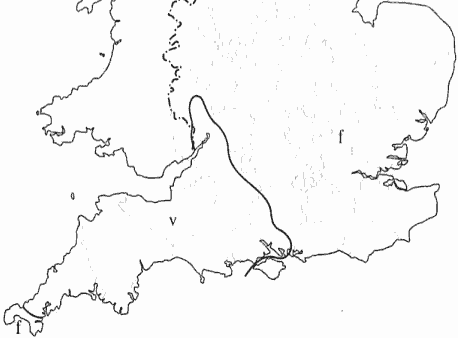
イングランドの最南西端,Cornwall の末端では標準的な [f] が行われているが,これは Cornwall 方言が南西部方言の英語の流れを汲むものではなく,近代期に従来のケルト系言語 Cornish を置き換えた標準英語にルーツをもつものだからである (cf. 「#779. Cornish と Manx」 ([2011-06-15-1]),「#2025. イングランドは常に多言語国だった」 ([2014-11-12-1])).
さて,現在では語頭の [f] に代わる [v] の分布は南西方言に限られているが,中英語期にはイングランド南部に広がっていた.この広い範囲で,おそらくすでに古英語期から語頭の摩擦音の有声化が始まっていたものと思われる.中英語での fader と vader の分布を Plan and Bibliography (9) に基づいた中尾 (101) の地図でみてみよう.
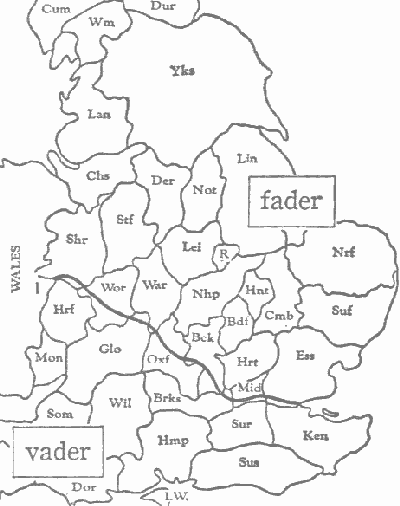
古英語では,南部諸方言で件の変化が生じるまでは,方言にかかわらず [v] と [z] は語頭に生じることはなかった.ところが,中英語では,この変化の生じた方言のみならず広く一般に両音が語頭に生じることが可能となった.Lass (58--59) は,この語頭音としての [v], [z] の一般的な許容の理由の1つは,まさに南部諸方言に生じた摩擦音有声化にあるとみている (cf. 「#1222. フランス語が英語の音素に与えた小さな影響」 ([2012-08-31-1])) .
A third factor, perhaps the most likely, was the existence in Middle English of varieties that had in Old English times undergone voicing of initial fricatives. Many southern dialects had voiced at least initial /f s/ --- a development whose relics survive still in the rural West Country ('Zummerzet'). This parallels, and may well stem from, the same process in continental West Germanic: the <v> in G Vater 'father', now pronounced with /f/, and Du. initial <v> and <z> in vader and zon 'sun' (/f s/ in more innovating dialects, still /v z/ in conservative ones) reflect this. While the voicing in England was mainly southern, it did extend well up into the midlands in Early Middle English, and the standard still has a number of forms with voiced initials like vat, vixen, vane (OE fæt, fyxen, fana). Contact between speakers of these dialects and others without voicing may have facilitated borrowing of French /v z/, making them less 'outlandish'.
・ Lass, Roger. "Phonology and Morphology." The Cambridge History of the English Language. Vol. 2. Cambridge: CUP, 1992. 23--154.
・ Upton, Clive and J. D. A. Widdowson. An Atlas of English Dialects. 2nd ed. Abingdon: Routledge, 2006.
・ Kurath, Hans, Margaret S. Ogden, Charles E. Palmer, and Richard L. McKelvery. Plan and Bibliography. U of Michigan P, 1954.
・ 中尾 俊夫 『英語史 II』 英語学大系第9巻,大修館書店,1972年.38頁.
2015-03-09 Mon
■ #2142. 中英語における3単現および複現の語尾の方言分布 [map][laeme][lalme][me_dialect][me][3sp][3pp][verb][conjugation][nptr]
標題の問いに手っ取り早く答えるには,次の表で事足りる(Görlach (68) による表の一部より).
| South | Midland | North | ||
| Present Indicative | 3sg. | -(e)þ | -(e)þ | -(e)s |
| pl. | -(e)þ | -(e)n | -(e)s | |
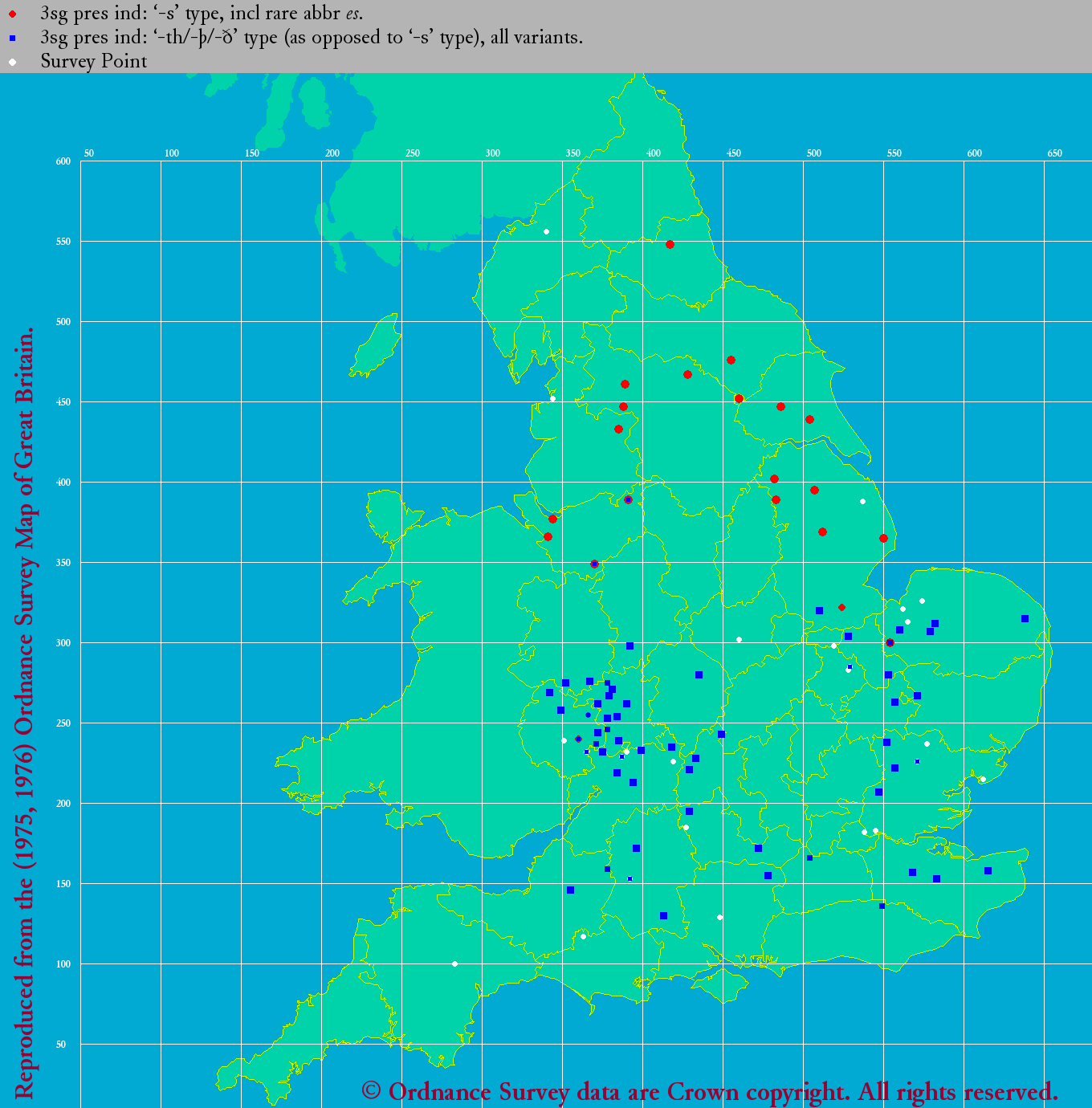
これを地図上に示すと「#790. 中英語方言における動詞屈折語尾の分布」 ([2011-06-26-1]) の通りとなるが,より詳しい分布を得たいときには LAEME (初期中英語)と eLALME (後期中英語)を参照するのが便利である (cf. 「#1622. eLALME」 ([2013-10-05-1])) .以下では,両アトラスより得られた地図の画像を貼り付けよう(クリックするとより大きく綺麗な画像が得られる).まずは,1150--1325年をカバーする LAEME より,3単現(左)と複現(右)の語尾の分布をそれぞれ示す.
 |
 |
| LAEME: 3sp 's' and 'th' | LAEME: pp 's', 'th', 'n', 'e', and zero |
両地図で北部に集まる赤丸が -s を,南部に集まる青四角が -th を表す.右の複現の語尾では東中部その他に黒三角が散在しているが,これは -n 語尾を表す.次に,複数代名詞と接する動詞の現在形が -e またはゼロの語尾をとる "Northern Present Tense Rule" (NPTR; cf. 「#689. Northern Personal Pronoun Rule と英文法におけるケルト語の影響」 ([2011-03-17-1]),nptr) の分布図を見よう.
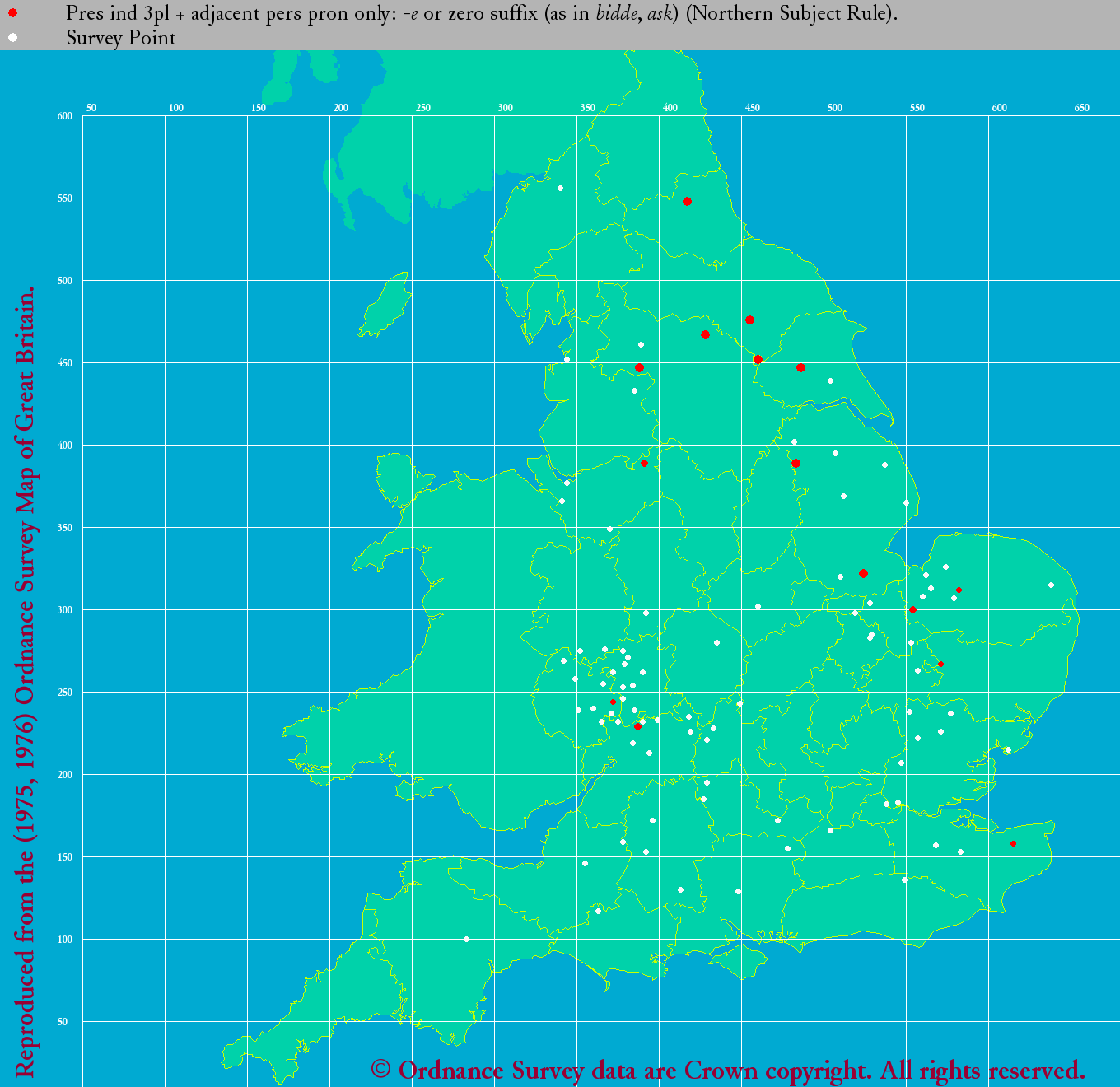
|
| LAEME: NPTR pp 'e' and zero |
では次に後期中英語の分布に移る.eLALME では,語尾の種類ごとに別々の地図を作成した.まずは3単現から.
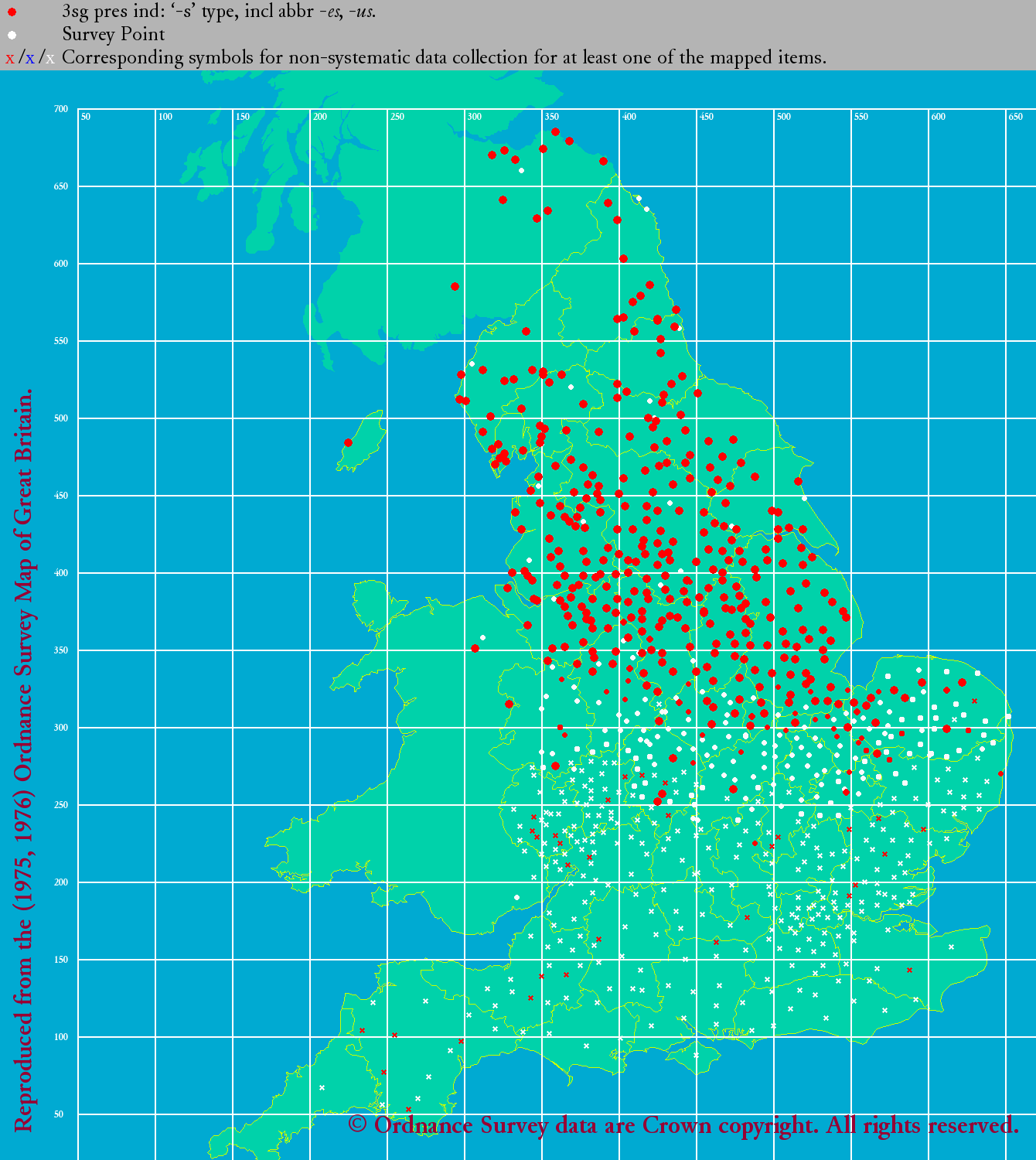 |
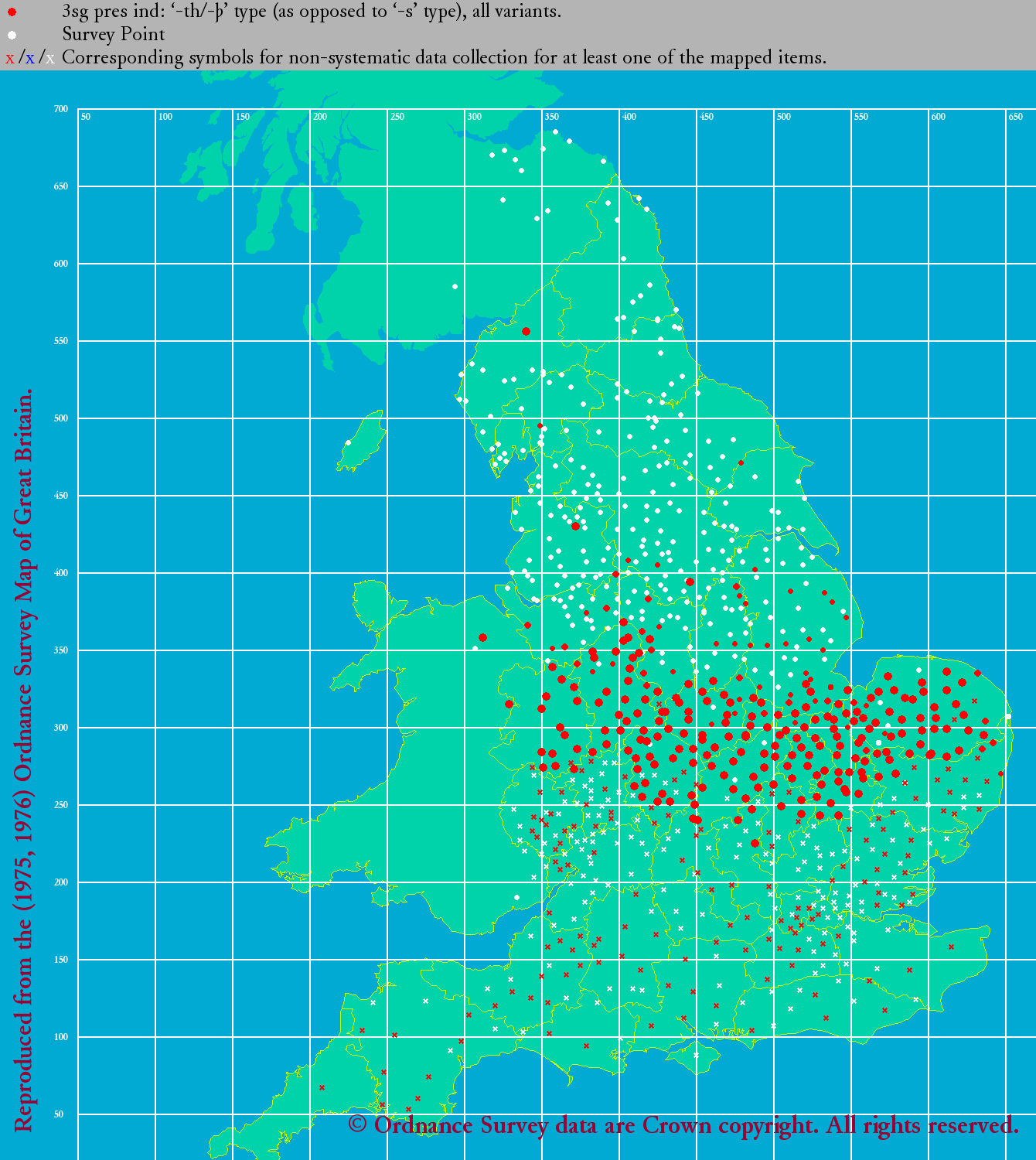 |
| eLALME: 3sp 's' | eLALME: 3sp 'th' |
前時代の分布をよく受け継いでおり,左図の通り -s が北部に,右図の通り -th が中部以南に分布しているのがわかる.複現については,-s, -th, -n, -e (or zero) の4種類について各々の地図を見てみよう.
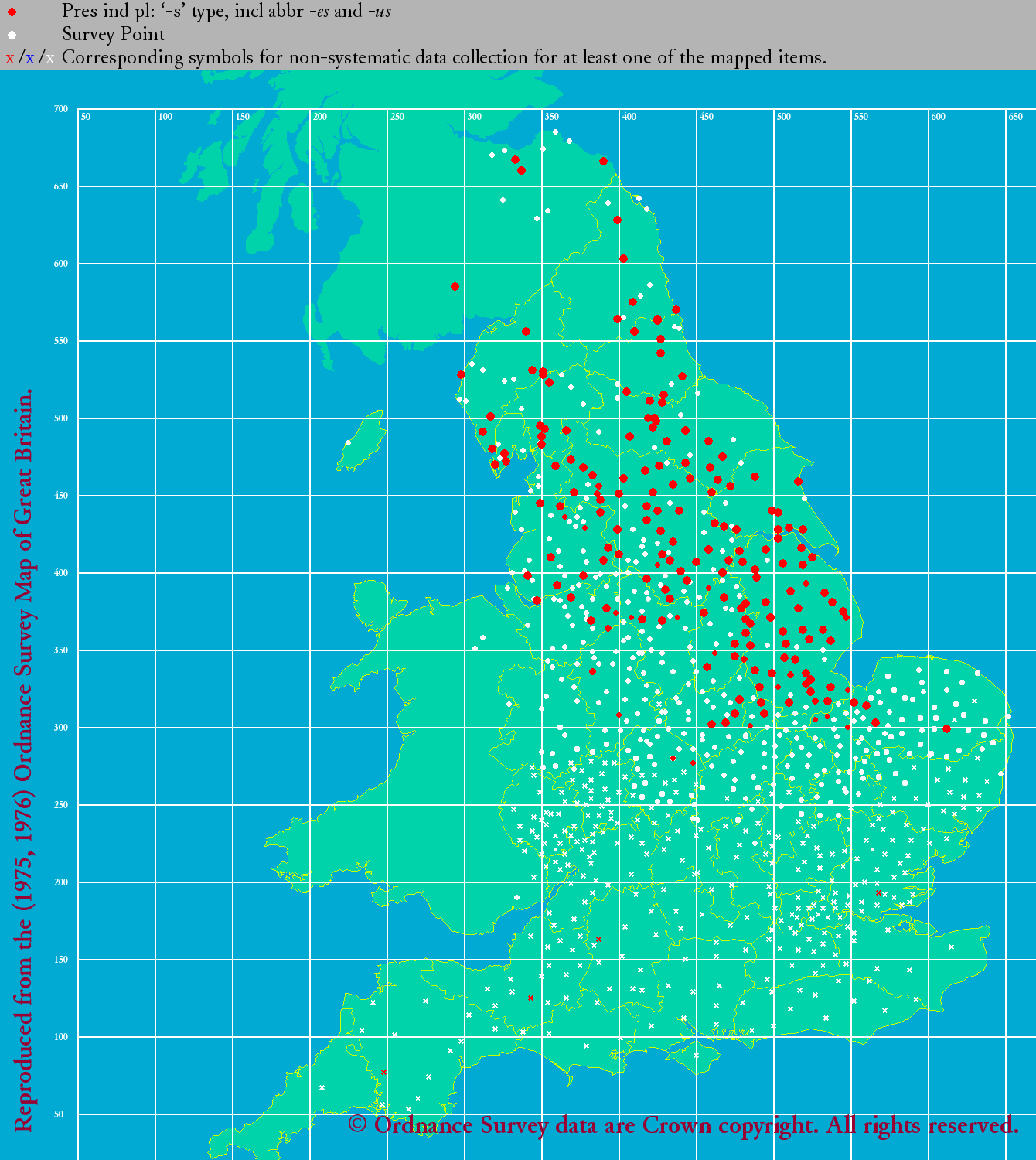 |
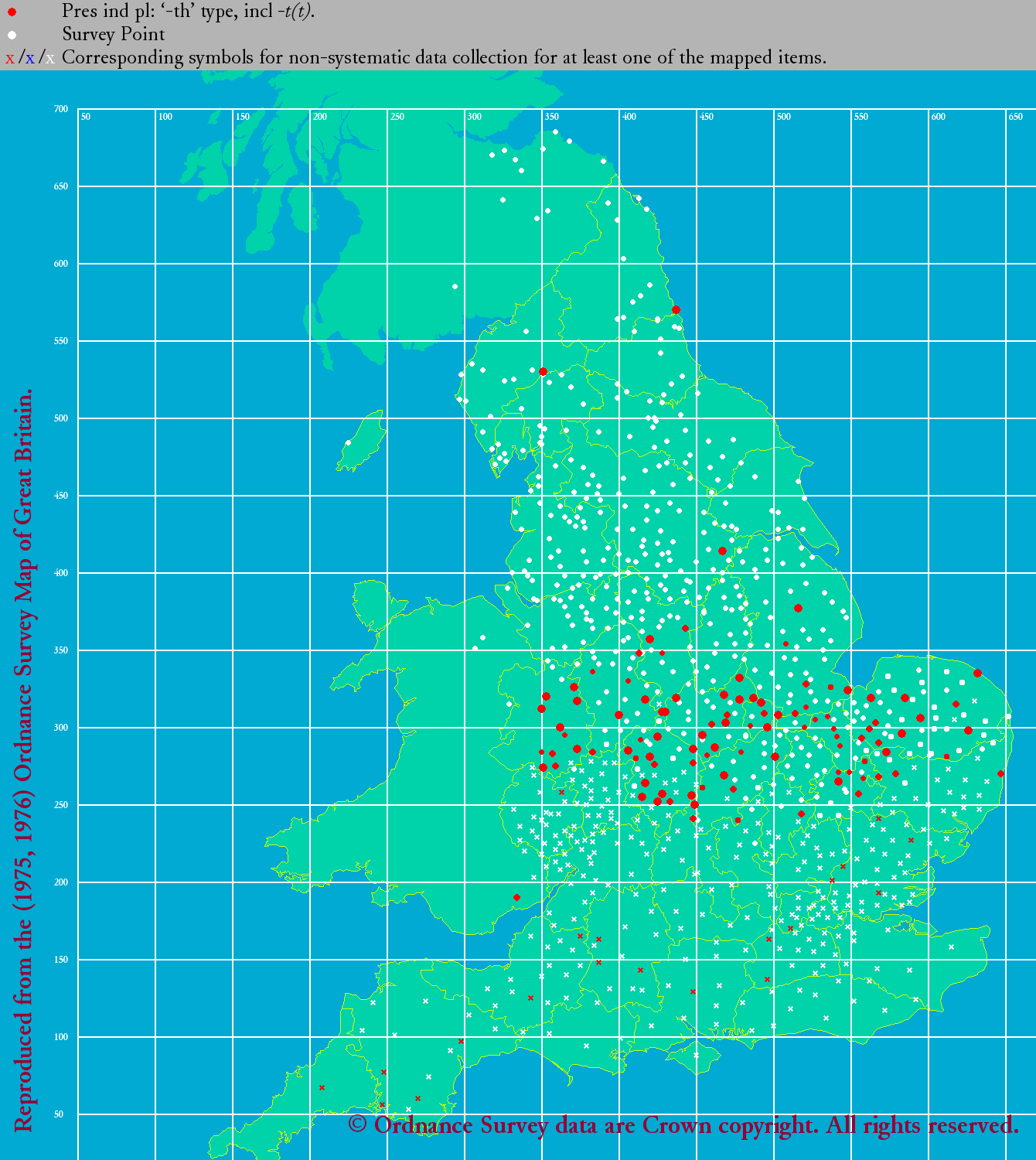 |
| eLALME: pp 's' | eLALME: pp 'th' |
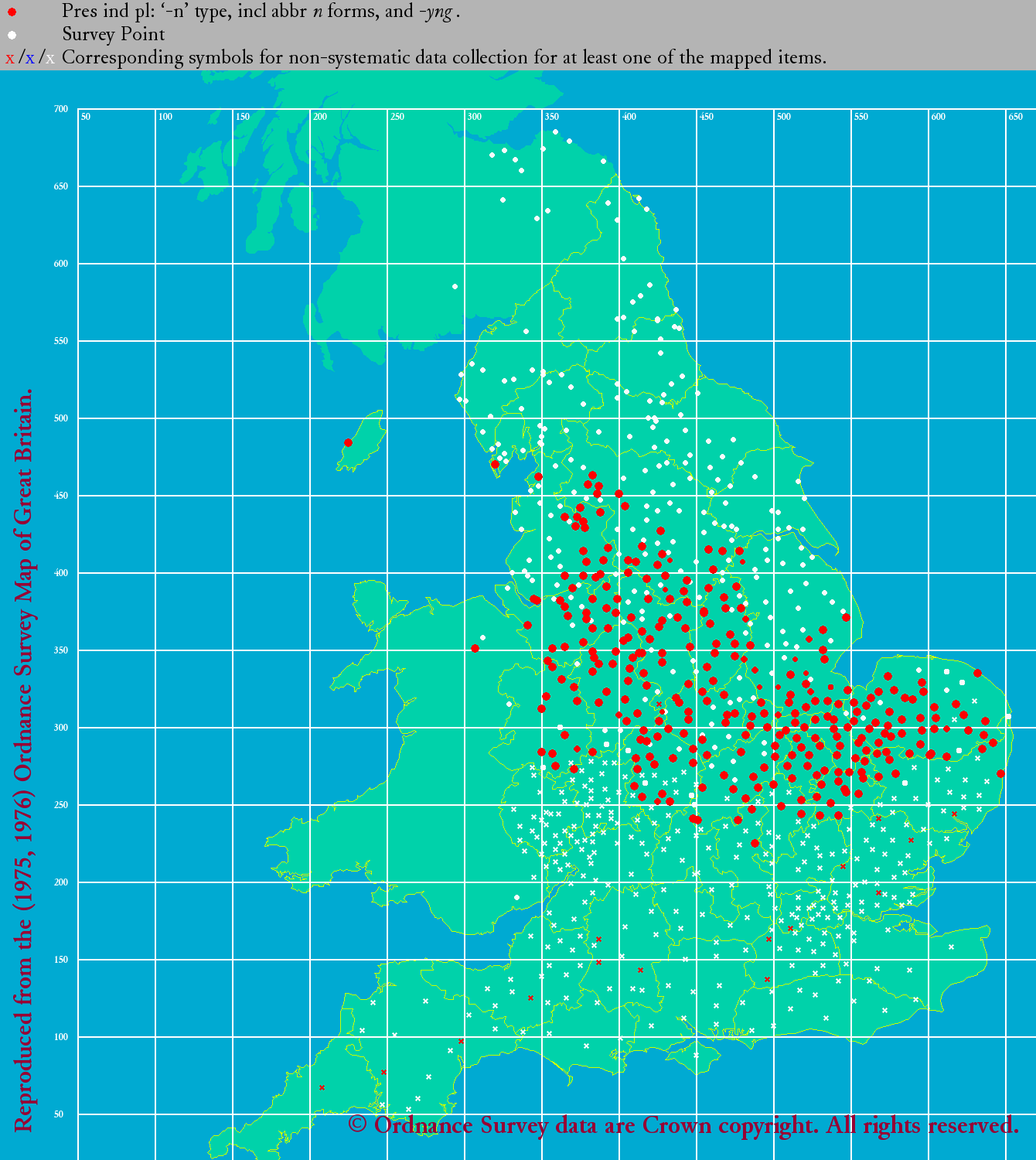 |
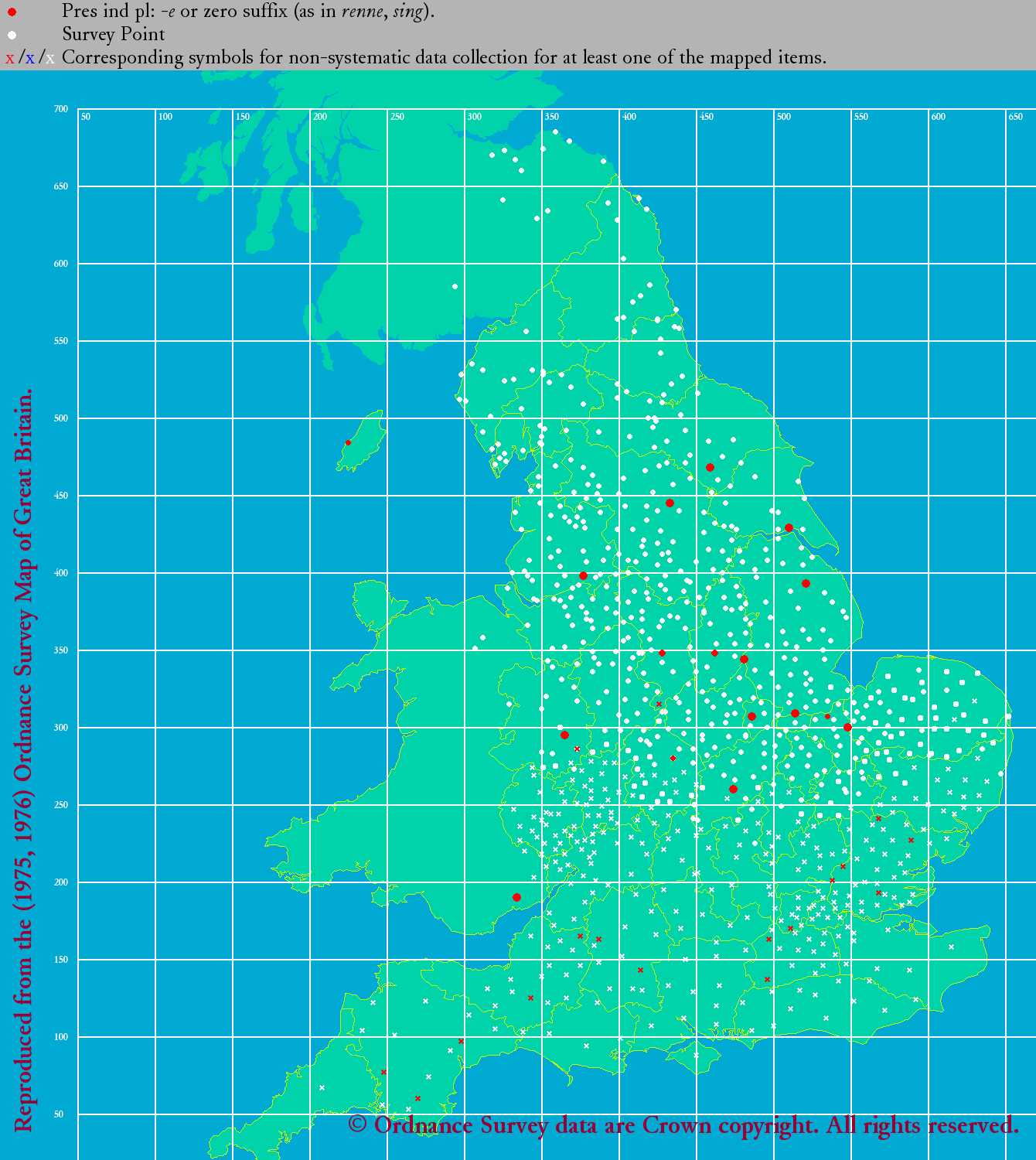 |
| eLALME: pp 'n' | eLALME: pp 'e' or zero |
こちらも前時代の分布をよく受け継いでおり,北部で -s (左上図),中部以南で -th (右上図)が優勢だが,中部で -n (左下図)が前時代よりも著しく拡張していることが見て取れる.全体的に,初期中英語と後期中英語の分布間で量的な差は見られるが,質的には大きな変化はないといってよいだろう. *
・ Görlach, Manfred. The Linguistic History of English. Basingstoke: Macmillan, 1997.
[ 固定リンク | 印刷用ページ ]
2015-01-12 Mon
■ #2086. Strang 曰く,「中英語は方言の時代」 [popular_passage][me_dialect][dialectology][standardisation][norman_conquest]
中英語が方言の時代であるということは,「#577. 中英語の密かなる繁栄」 ([2010-11-25-1]) や「#929. 中英語後期,イングランド中部方言が標準語の基盤となった理由」 ([2011-11-12-1]) ほか me_dialect の各記事で直接間接に話題にしてきた.ただし,この謂いに関して誤解してはいけないのは,英語史において方言は中英語期に限らずいつでも行われていたのであり,英語話者は古代から現代に至るまで常に母方言を用いてきたということだ.
中英語が方言の時代であるとあえて主張するのは,英語史上この時期がある点において特異だからだ.それは,この時代に書き表わされ現在に伝わっているテキストの言葉がすべて方言であるということだ.書き言葉において(そして話し言葉においても)標準英語なるものは存在せず,実際に行われていたものは英語の諸方言にすぎない.中英語の書き手の各々は,これら方言のいずれかを母方言とする方言の話し手であり,書き手でもあった.古英語,近代英語,現代英語にも方言の書き手はいたが,一般にはその時代その時代に確立した(しつつあった)ある種の標準英語で読み書きしたのであり,方言が書き言葉に直接付されるという機会は稀だった.中英語は,書き記されるべき標準英語がなかったという意味で,書き言葉上,方言の時代と呼ばれるのである.
中英語に標準英語がなかった,より正確にいえば後期まで標準化の兆しすら生じなかったのは,ノルマン征服によって古英語後期の標準英語といえる後期ウェストサクソン方言がその標準的な地位を失い,その後も英語諸方言は圧倒的な権威を誇るフランス語のくびきのもとで標準化の機会さえ与えられなかったからである.「#1919. 英語の拡散に関わる4つの crossings」 ([2014-07-29-1]) で,古英語から中英語にかけての標準英語変種の衰退と消滅を "the first decline" と呼んだとおりである.中英語が方言の時代として現われる前提として,社会的な大異変と,それに伴う社会言語学的な求心力の低下があったのだ.
中英語が方言の時代であることを最も雄弁に主張したのは Strang (224--25) だろう.以下に引用しておこう.
ME is, par excellence, the dialectal phase of English, in the sense that while dialects have been spoken at all periods, it was in ME that divergent local usage was normally indicated in writing. It was preceded by a phase in which the language had one kind of written standard . . . and followed by a phase in which it had others. It stands alone as having a rich and varied documentation in localised varieties of English, and dialectology is more central to the study of ME than to any other branch of English historical linguistics.
・ Strang, Barbara M. H. A History of English. London: Methuen, 1970.
2014-12-11 Thu
■ #2054. seek と beseech の語尾子音 (2) [consonant][phonetics][inflection][palatalisation][old_norse][contact][analogy][me_dialect]
「#2015. seek と beseech の語尾子音」 ([2014-11-02-1]) を書いた後で,Krygier による関連する論文を読んだ.前の記事の最後で,seek の末尾の /k/ 音は北部方言で行われたと想像される古ノルド語の同根語の /k/ 音の影響によるものではないかという説を紹介したが,Krygier はその説を強く支持している.丁寧で説得力がある議論なので,概要を記しておきたい.
前の記事でも説明したとおり,古英語の対応する不定詞は sēċan であり,問題の子音は軟口蓋破裂音 [k] ではなく,硬口蓋化した破擦音 [ʧ] だった.この口蓋化の過程は,Gmc *sōkjan において口蓋音 [j] が後続していたことにより引き起こされたものである.古英語の現在形屈折では口蓋化された [ʧ] が現われるが,2人称単数と3人称単数の屈折形のみは sēcst, sēcþ のように軟口蓋破裂音 [k] を示した(このパラダイム内での交替については音韻論的な議論があるが,ここでは省略する).伝統的な見解によると,この2・3人称単数の [k] がパラダイム内に広がり,不定詞や1人称単数などすべての屈折形が [k] を示すに至ったとされる.類推 (analogy) のなかでもパラダイム内での水平化 (levelling) と呼ばれる類いの過程が生じたとする説だ (cf. 「#555. 2種類の analogy」 ([2010-11-03-1])) .Hogg (§7.42) もこの説を支持している.
Following general principles of analogy . . . we would expect the nom.sg. to predominate over plural forms in nouns, and in strong verbs the present forms similarly to predominate over past forms. . . . In the present tense of weak verbs the alternation type sēcan ? sēcþ is, as would be predicted, the source of later seek, cf. beseech, where the affricate has been extended, perhaps on pragmatic grounds, and so for other similar verbs, such as think, work.
しかし,Krygier は,この類推説に疑問を向ける.通常,類推作用は有標な形式が無標な形式へ呑み込まれていく過程である.そうであれば,sēċan の場合,むしろ不定詞や1人称単数形などの [ʧ] をもつ形態が無標とみなされるはずだから,[ʧ] へ水平化してゆくのが筋だろう.ところが,事実は反対である.上の引用にもある通り,むしろ [ʧ] へ水平化した beseech に関してこそこの類推説は説得力をもつのであり,seek について同じ類推説を持ち出すことは難しいのではないか.
そこで Krygier は,seek と同じ形態クラスに属する動詞(語幹末に [k] をもつ弱変化I類の動詞)のリストを作った (catch (OFr cachier), dretch (OE dreccan), letch (OE læccan), quetch (OE cweccan), reach (OE rǣcan), reach (2) (OE reccan), rech (OE reccan), seek (OE sēcan), stretch (OE streccan), teach (OE tǣcan), think (OE þencan ? þyncan), watch (OE w(r)eccan), work (OE wyrcan)) .そして,この13個の動詞について,5つに区分した中英語方言からの例を拾い出し,[k] を示すか [ʧ] を示すかを数え上げた.その結果,動詞全体としても方言全体としても [ʧ] が優勢だが,北部と東中部ではいくつかの動詞についてむしろ [k] が優勢であることが,そして少なくとも他方言に比べて相対頻度が著しいことが,わかった.具体的には,Hogg の引用から予想されるように,seek, think, work の3語がそのような分布を示した (Krygier 465) .
北部系方言で語によって [k] が優勢であるということは,古ノルド語の関与を疑わせる.実際,上に挙げた動詞の対応する古ノルド語形には [k] が現われる.問題の3語についていえば,古ノルド語形は sœkja, þekkja/þykkja, yrkja である.南部系方言の状況は類推説のみでうまく説明できるが,北部系方言の状況を説明するには古ノルド語形の参与を考えざるを得ないということになる.あとは,北部系の [k] が後に南下し標準形として採用されたというシナリオを想定するのみだ.seek と beseech が平行的に発達しなかったのは,古ノルド語 sœkja は文証されるが *besœkja は文証されないということも関係しているのではないか (Krygier 468) .
Krygier (468) の結論部が非常に明解なので,引用しておく.
By way of a summary, the following interpretation of the developments in the "seek"-group regarding velar restoration can be proposed. The Present-day English situation is a result of an interplay of two factors. One of them is analogical levelling of the alternations resulting from Primitive Old English syncope of medial unstressed [i]. Contrary to earlier scholarship, however, a path of development parallel to that in strong verbs is postulated, thus removing the minority velar forms from second and third person singular present tense. This would give palatal consonants throughout the present paradigm in all dialects of Late Old English/Early Middle English. On this pattern the influence of Old Norse equivalents of the "seek"-verbs should be superimposed. For obvious reasons, initially it was limited mainly to the north-east, later spreading southwards, with West Midlands as a possible relic area. The absence of an Old Norse equivalent would favour the preservation of the palatal type, while its existence would further velar restoration, as best exemplified by the seek ? beseech contrast. In individual cases other factors, such as the existence of etymologically related Old English words with a velar, e.g., wyrcan : weorc, could have played a secondary role, which can probably be seen primarily in isolated velar forms in the south.
・ Krygier, Marcin. "Old English (Non)-Palatalised */k/: Competing Forces of Change at Work in the "seek"-Verbs." Placing Middle English in Context. Ed. I. Taavitsainen et al. Berlin: Mouton de Gruyter, 2000. 461--73.
・ Hogg, Richard M. A Grammar of Old English. Vol. 1. Phonology. Oxford: Blackwell, 1992.
2014-07-12 Sat
■ #1902. 綴字の標準化における時間上,空間上の皮肉 [standardisation][spelling][orthography][chancery_standard][me_dialect][geolinguistics][gvs][spelling_pronunciation_gap][gh]
英語史では,書き言葉の標準化の基礎は,14世紀後半から15世紀にかけてのロンドンで築かれたと考えられている.本ブログでは,「#306. Samuels の中英語後期に発達した書きことば標準の4タイプ」 ([2010-02-27-1]),「#929. 中英語後期,イングランド中部方言が標準語の基盤となった理由」 ([2011-11-12-1]),「#1228. 英語史における標準英語の発展と確立を巡って」 ([2012-09-06-1]),「#1245. 複合的な選択の過程としての書きことば標準英語の発展」 ([2012-09-23-1]) などの記事で取り上げてきた.
この時代の後,初期近代英語にかけて印刷術が導入され発展したことも,綴字の標準化の流れに間接的な影響を及ぼしたと考えられている.「#297. 印刷術の導入は英語の標準化を推進したか否か」 ([2010-02-18-1]) ,「#871. 印刷術の発明がすぐには綴字の固定化に結びつかなかった理由」 ([2011-09-15-1]) ,「#1312. 印刷術の発明がすぐには綴字の固定化に結びつかなかった理由 (2)」 ([2012-11-29-1]) でみたように,最近はこの意見に対して異論も出ているが,少なくとも英語史上のタイミングとしては,印刷術の登場の時期と綴字の標準化が緩やかに進んでいた時期とはおよそ重なっている.
一方,後期中英語から初期近代英語にかけてのこの時期に,話し言葉では著しい音韻変化が数多く起こっていた.大母音推移 (Great Vowel Shift; [2009-11-18-1]) を筆頭に,「#1290. 黙字と黙字をもたらした音韻消失等の一覧」 ([2012-11-07-1]) で挙げたような種々の子音の消失が進行していた.話し言葉が著しく変化していたにもかかわらず,書き言葉は標準化の方向を示していたということは,歴史上の皮肉と言わざるをえない.おかげで,近現代英語で綴字と発音の乖離 (spelling_pronunciation_gap) が生じてしまった.
このような流れを指して,英語の綴字の標準化は,歴史上,皮肉なタイミングで生じてしまったといわれる.しかし,言語変化の早晩や遅速という時間差は,部分的には,北部方言と南部方言という空間差と対応しているとみることもでき,その意味ではここで問題にしていることは,歴史の皮肉であるとともに地理の皮肉でもあるのかもしれないのだ.換言すれば,英語史における綴字の標準化の皮肉は,その基礎が14--15世紀に築かれたという事実だけでなく,主として南部方言に属するロンドンの地で築かれたという事実にも関係している.Horobin (84--85) が指摘しているように,同時代の北部方言に比してずっと保守的だった南部のロンドン方言が,綴字の標準化の基盤に据えられたことの意味は大きい.
例えば,北部方言では,<gh> などの綴字で表わされていた /ç, x/ はすでに無音となっており,"knight" は <nit>, "doughter" は <datter> などと綴られていた.一方,南部方言ではこの子音はいまだ失われておらず,したがって <gh> の綴字も保存され,近現代の標準的な綴字 <knight>, <doughter> のなかに固定化することになった.この /ç, x/ の消失という音韻変化は後に南部方言へも及んだので,結局,標準的な綴字が <nit> となるか <knight> となるかの差は,時間差であるとともに方言差であるとも考えられることになる.標準化した <wh> の綴字についても同じことがいえる.当時,いくつかの方言ですでに /h/ が失われていたが,保守的なロンドンの発音においては /h/ が保たれていたために,後の標準的な綴字のなかにも <h> として固定化することになってしまった.これらの例を歴史的に評価すれば,発音については進歩的な北部方言的なものが多く標準の基盤となり,綴字については保守的な南部方言的なものが多く標準の基盤となった,といえるだろう.関連して,中英語の言語変化の「北から南へ」の波状伝播について,「#941. 中英語の言語変化はなぜ北から南へ伝播したのか」 ([2011-11-24-1]) および「#1843. conservative radicalism」 ([2014-05-14-1]) を参照されたい.
なお,語末の /x/ に関して,北部方言では /f/ へと発展し,dough (練り粉)に対応する方言形 duff (ダフ;小麦粉の固いプディング)が後に南部へ借用された例がある(「#1195. <gh> = /f/ の対応」 ([2012-08-04-1]) も参照).このように発音と綴字との関係が密である例がもっと多かったならば,近現代の標準的な綴字ももっと素直なものになったことだろう.やはり,英語の綴字の標準化には,時間の皮肉だけでなく空間の皮肉も混じっている.
・ Horobin, Simon. Does Spelling Matter? Oxford: OUP, 2013.
2014-05-23 Fri
■ #1852. 中英語の方言における直説法現在形動詞の語尾と NPTR [nptr][verb][conjugation][inflection][me_dialect][contact][suffix][paradigm][3pp][3sp]
標題は「#790. 中英語方言における動詞屈折語尾の分布」 ([2011-06-26-1]) でも簡単に触れた話題だが,今回はもう少し詳しく取り上げたい.注目するのは,直説法の3人称単数現在の語尾と(人称を問わない)複数現在の語尾である.
中英語の一般的な方言区分については「#130. 中英語の方言区分」 ([2009-09-04-1]) や「#1812. 6単語の変異で見る中英語方言」 ([2014-04-13-1]) を参照されたいが,直説法現在形動詞の語尾という観点からは,中英語の方言は大きく3分することができる.いわゆる "the Chester-Wash line" の北側の北部方言 (North),複数の -eth を特徴とする南部方言 (South),その間に位置する中部方言 (Midland) である.中部と南部の当該の語尾についてはそれぞれ1つのパラダイムとしてまとめることができるが,北部では「#689. Northern Personal Pronoun Rule と英文法におけるケルト語の影響」 ([2011-03-17-1]) で話題にしたように,主語と問題の動詞との統語的な関係に応じて2つのパラダイムが区別される.この統語規則は "Northern Personal Pronoun Rule" あるいは "Northern Present Tense Rule" (以下 NPTR と略)として知られており,McIntosh (237) によれば,次のように定式化される.
Expressed in somewhat simplified fashion, the rule operating north of the Chester-Wash line is that a plural form -es is required unless the verb has a personal pronoun subject immediately preceding or following it. When the verb has such a subject, the ending required is the reduced -e or zero (-ø) form.
McIntosh (238) にしたがい,NPTR に留意して中英語3方言のパラダイムを示すと以下のようになる.
(1) North (north of the Chester-Wash line)
i) subject not a personal pronoun in contact with verb
| North: i) | sg. | pl. |
|---|---|---|
| 1st person | -es | |
| 2nd person | ||
| 3rd person | -es |
ii) personal pronoun subject in contact with verb
| North: ii) | sg. | pl. |
|---|---|---|
| 1st person | -e, -ø (-en) | |
| 2nd person | ||
| 3rd person | -es |
(2) Midland
| Midland | sg. | pl. |
|---|---|---|
| 1st person | -en, -e (-ø) | |
| 2nd person | ||
| 3rd person | -eth |
(3) South
| South | sg. | pl. |
|---|---|---|
| 1st person | -eth | |
| 2nd person | ||
| 3rd person | -eth |
さて,おもしろいのは北部と中部の境界付近のある地域では,NPTR を考慮するパラダイム (1) とそれを考慮しないパラダイム (2) とが融合したような,パラダイム (1.5) とでもいうべきものが確認されることである.そこでは,パラダイム (1) に従って統語的な NPTR が作用しているのだが,形態音韻論的にはパラダイム (1) 的な -es ではなくパラダイム (2) 的な -eth が採用されているのである.McIntosh (238) により,「パラダイム (1.5)」を示そう.
(1.5) (1) と (2) の境界付近の "NE Leicestershire, Rutland, N. Northamptonshire, the extreme north of Huntingdonshire, and parts of N. Ely and NW Norfolk" (McIntosh 236)
i) subject not a personal pronoun in contact with verb
| North/Midland: i) | sg. | pl. |
|---|---|---|
| 1st person | -eth | |
| 2nd person | ||
| 3rd person | -eth |
ii) personal pronoun subject in contact with verb
| North/Midland: ii) | sg. | pl. |
|---|---|---|
| 1st person | -en (-e, -ø) | |
| 2nd person | ||
| 3rd person | -eth |
要するに,この地域では,形態音韻は中部的,統語は北部的な特徴を示す.統語論という抽象的なレベルでの借用と考えるべきか,dialect mixture と考えるべきか,理論言語学的にも社会言語学的にも興味をそそる現象である.
・ McIntosh, Angus. "Present Indicative Plural Forms in the Later Middle English of the North Midlands." Middle English Studies Presented to Norman Davis. Ed. Douglas Gray and E. G. Stanley. Oxford: OUP, 1983. 235--44.
Powered by WinChalow1.0rc4 based on chalow