2013-04-15 Mon
■ #1449. 言語における「範疇」 [category][number][gender][tense][aspect][person][mode][terminology][sapir-whorf_hypothesis][linguistic_relativism]
言語学では範疇 (category) という術語が頻用される.もともとは哲学用語であり,日本語の「範疇」は,中国の『書経』の「洪範九疇」ということばをもとに,英語 category やドイツ語 Kategorie の訳語として,明治時代の西洋哲学の移入時に,井上哲次郎(一説に西周)が作ったものとされる.原語はギリシア語の katēgoríā であり,その動詞 katēgoreîn は kata- (against) + agoreúein (to speak in the assembly) から成る.「公の場で承認されうる普遍的な概念の下に包みこんで訴える」ほどの原義に基づいて,アリストテレスは「分類の最も普遍的な規定,すなわち最高類概念」の語義を発展させ,以降,非専門的な一般的な語義「同じ種類のものの所属する部類・部門」も発展してきた.
英語の category も,まずは16世紀末に哲学用語としてラテン語から導入され,17世紀中葉から一般用語として使われ出した.現在では,OALD8 の定義は "a group of people or things with particular features in common" とあり,日常化した用語と考えてよい.
では,言語学で用いられる「範疇」とは何か.さすがに専門用語とだけあって,日常的な単なる「部類・部門」の語義で使われるわけではない.では,言語的範疇の具体例を見てみよう.英文法では文法範疇 (grammatical category) ということが言われるが,例えば数 (number) ,人称 (person) ,時制 (tense) ,法 (mode) などが挙げられる.これらは動詞を中心とする形態的屈折にかかわる範疇だが,性 (gender or sex) など語彙的なものもあるし,定・不定 (definiteness) や相 (aspect) などの統語的なものもある.これらの範疇は英文法の根本にある原理であり,文法記述に欠かせない概念ととらえることができる.これで理解できたような気はするが,では,言語的範疇をずばり定義せよといわれると難しい.このもやもやを解決してくれるのは,Bloomfield の定義である.以下に引用しよう.
Large form-classes which completely subdivide either the whole lexicon or some important form-class into form-classes of approximately equal size, are called categories. (270)
文法性 (gender) で考えてみるとわかりやすい.名詞という語彙集合を前提とすると,例えばフランス語には形態的,統語的な振る舞いに応じて,規模の大きく異ならない2種類の部分集合が区別される.一方を男性名詞と名付け,他方を女性名詞と名付け,この区別の基準のことを性範疇を呼ぶ,というわけである.
category の言語学的用法が一般的用法ではなく哲学的用法に接近していることは,言語的範疇がものの見方や思考様式の問題と直結しやすいからである.この点についても,Bloomfield の説明がすばらしい.
The categories of a language, especially those which affect morphology (book : books, he : she), are so pervasive that anyone who reflects upon his language at all, is sure to notice them. In the ordinary case, this person, knowing only his native language, or perhaps some others closely akin to it, may mistake his categories for universal forms of speech, or of "human thought," or of the universe itself. This is why a good deal of what passes for "logic" or "metaphysics" is merely an incompetent restating of the chief categories of the philosopher's language. A task for linguists of the future will be to compare the categories of different languages and see what features are universal or at least widespread. (270)
・ Bloomfield, Leonard. Language. 1933. Chicago and London: U of Chicago P, 1984.
2010-10-13 Wed
■ #534. The General Prologue の冒頭の現在形と完了形 [chaucer][tense][aspect][popular_passage][perfect][voicy]
Chaucer の The Canterbury Tales の "The General Prologue" から,あまりにも有名な冒頭の1文を引く( ll. 1--18 from The Riverside Chaucer )
Whan that Aprill with his shoures soote
The droghte of March hath perced to the roote,
And bathed every veyne in swich licour
Of which vertu engendred is the flour;
Whan Zephirus eek with his sweete breeth
Inspired hath in every holt and heeth
The tendre croppes, and the yonge sonne
Hath in the Ram his half cours yronne,
And smale foweles maken melodye,
That slepen al the nyght with open ye
(So priketh hem nature in hir corages),
Thanne longen folk to goon on pilgrimages,
And palmeres for to seken straunge strondes,
To ferne halwes, kowthe in sondry londes;
And specially from every shires ende
Of Engelond to Caunterbury they wende,
The hooly blisful martir for to seke,
That hem hath holpen whan that they were seeke.
初めて読んだ中英語の文章がこの文だったという人も多いのではないだろうか.格調の高い長い書き出しだが,基本的な文の構造としては Whan . . . Thanne の相関構文であり明快だ.この文の味わい方は読者の数だけあるのかもしれないが,今回は Burnley (46--47) に従って時制 ( tense ) と相 ( aspect ) に注目した読み方を紹介したい.
まず,用いられている動詞の時制はほぼ現在で統一されている(唯一の例外は最後の行の were のみ).語りの前提のない書き出しでの現在形使用は,普遍性を感じさせる.4月が訪れ,自然が目覚め出すと同時に,人もやむにやまれずカンタベリーへの巡礼を思い立つ,ということが毎年のように繰り返されていることが暗示される.自然の循環,季節の回帰を想起させる,高らかな謳いだしである.
相 ( aspect ) に目を移すと,Whan 節の内部では主として完了形が用いられている.これは Whan 節とそれに続く Thanne 節の内容が時間的に間をおかずに継起していることを示すとともに,単に時間的継起のみならず因果関係をも示唆している.人々が巡礼を思い立つのは,他ならぬ4月の自然の引き金によるものなのだ.長い文でありながら,Whan 節と That 節の内容が緊密に結びついているのは,完了形の力ゆえである.
まとめれば,この冒頭の文では「自然の目覚め→人々の目覚め」という因果関係が毎年のように繰り返されるという普遍性を謳っていることになる.この文の後には "Bifil that in that seson on a day," と過去形での語りが始まるので,対照的に冒頭の現在時制とそれが含意する普遍性が際立つことになる.以上,有名な冒頭を時制と相によって読んでみた.
(後記 2022/05/03(Tue):Voicy 「英語の語源が身につくラジオ (heldio)」にて,この1節を中英語の発音で読み上げていますのでご参照ください.「中英語をちょっとだけ音読 チョーサーの『カンタベリ物語』の冒頭より」です.)
(後記 2023/10/10(Tue):Ellesmere MS の冒頭部分の画像は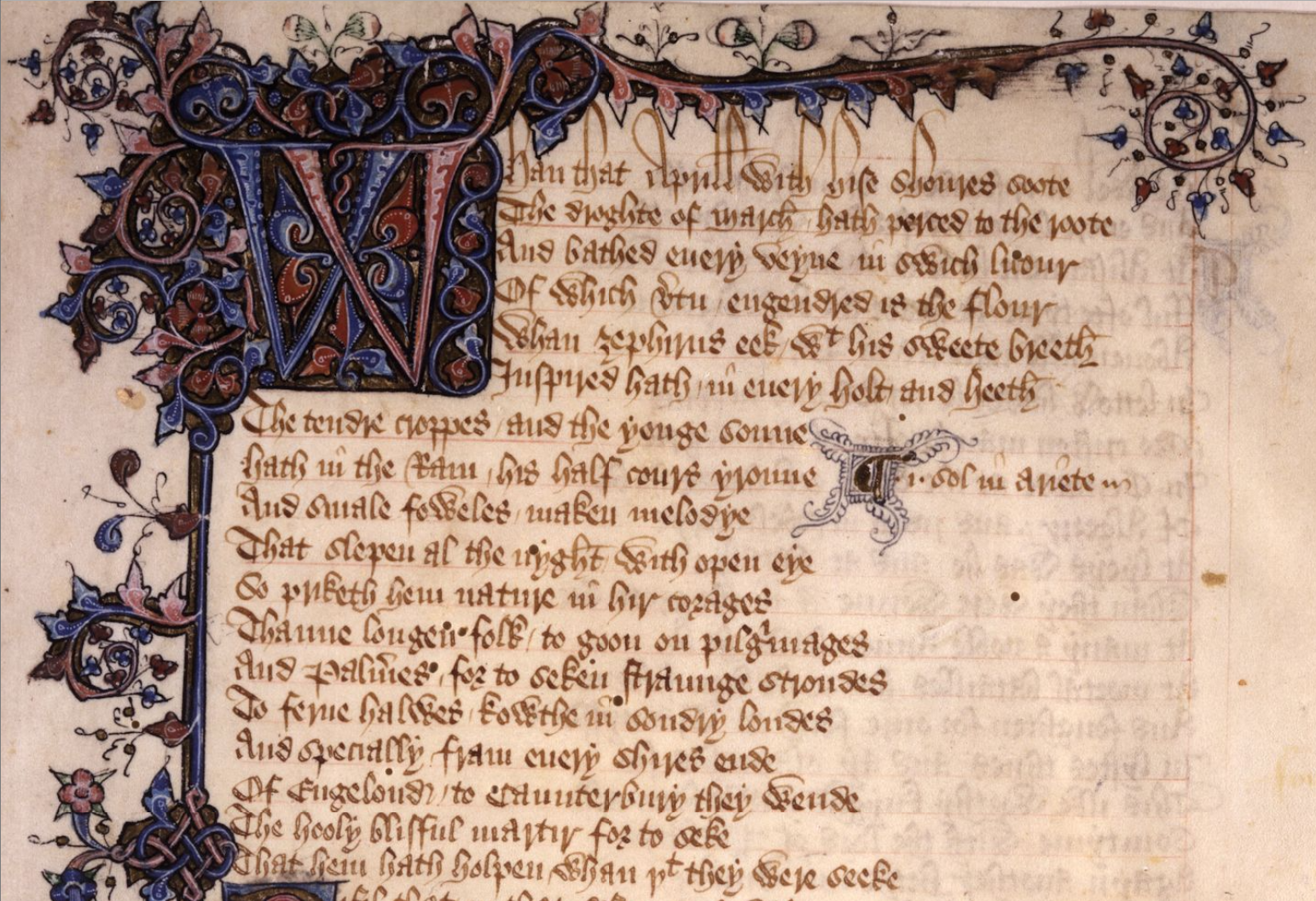 です.)
・ Burnley, David. The Language of Chaucer. Basingstoke: Macmillan Education, 1983. 13--15.
2010-07-22 Thu
■ #451. shall と will の使い分けに関する The Wallis Rules [prescriptive_grammar][auxiliary_verb][wallis][tense][future]
現代英語の助動詞の用法のなかでもとりわけ面倒なのが shall と will である.しかし,文法書ではこれらの助動詞の使い分けは明記されており,規範文法の典型的な項目とも言える.このルールを制定したのは17世紀の規範文法家 John Wallis である.Wallis ( 1616--1703 ) は,1653年に出版したラテン語による英文法書 Grammatica Linguae Anglicanae のなかで,次のような使い分けを定式化した.現代に至るまで影響力を保ち続けているこのルールは The Wallis Rules と呼ばれている ( Brinton and Arnovick, p. 370--71 ) .
| to promise: | to question determination/obligation: | ||
| I will (go) | We will (go) | Shall I (go)? | Shall we (go)? |
| You shall (go) | You shall (go) | Will you (go)? | Will you (go)? |
| He/she/it shall (go) | They shall (go) | Shall he/she/it (go)? | Shall they (go)? |
| to predict: | to question prediction: | ||
| I shall (go) | We shall (go) | Will I (go)? | Will we (go)? |
| You will (go) | You will (go) | Shall you (go)? | Shall you (go)? |
| He/she/it will (go) | They will (go) | Will he/she/it (go)? | Will they (go)? |
shall と will が人称,用法,平叙・疑問に応じてみごとな相補分布 ( complementary distribution ) をなしていることがわかる.一見すると混乱しそうだが,相補分布に整理された体系なので眺めていると理解できる.だが,言語は体系的であるとはいいながらも,ここまで合わせ鏡のようにうまくできているのはいかにも人工的という感じがする.言語体系の合理性 ( reason ) と透明性 ( transparency ) を信じ,それを獲得するために類推 ( analogy ) を適用した Wallis のルールは,17,18世紀の規範文法家の典型的な思考回路を表している.
The Wallis Rule は現代英語でいまだ影響力があるとはいっても,それは規範文法の話で,実際上は shall の使用は衰退してきている.特にアメリ英語では消えかけているといってよい.shall と will に関連する話題は,[2010-03-21-1], [2010-02-22-1]にもあり.
ちなみに,Wallis は無限記号∞を考案し,二項定理や微積分の基礎を築いた,Newton 以前の英国最大の数学者である.
・ Brinton, Laurel J. and Leslie K. Arnovick. The English Language: A Linguistic History. Oxford: OUP, 2006.
2010-02-15 Mon
■ #294. Chaucer の tense switching [chaucer][tense][historic_present]
Chaucer の作品を読んでいると,現代の標準的な書き言葉英語では許されない類の時制の転換が見られる.過去の出来事を語る一連の文章中で,現在形と過去形の動詞があたかもランダムに入れ替わるのである.以下に The Reeve's Tale (lines 4057--72) からの例をのぞいてみよう.赤字が動詞の現在形,青字が動詞の過去形を表す.わずか16行の間に目まぐるしい tense switching が起こっていることがわかる.
Out at the dore he gooth ful pryvely,Whan that he saugh his tyme, softely.He looketh up and doun til he hath foundeThe clerkes hors, ther as it stood yboundeBihynde the mille, under a lefesel;And to the hors he goth hym faire and wel;He strepeth of the brydel right anon.And whan the hors was laus, he gynneth gonToward the fen, ther wilde mares renne,And forth with wehee, thurgh thikke and thurgh thenne.This millere gooth agayn, no word he seyde,But dooth his note, and with the clerkes pleyde,Til that hir corn was faire and well ygrounde.And whan the mele is sakked and ybounde,This John goth out and fynt his hors away,And gan to crie "Harrow!" and "Weylaway!"
Chaucer の tense switching の問題はいろいろな形で研究されてきているようで,継続と完了の相 ( aspect ) の転換を示す役割があるとか,過去の叙述における現在形の使用によって物語の枠外にも当てはまる一般的・普遍的な内容を表す,などの案が提示されている (Horobin 8--10).しかし,この文脈では相や普遍性などを持ち出して説明することはできない.ここでの説明は,いわゆる historic present 「歴史的現在」 の用法ではないか.historic present は現代英語でも状況を生き生きと描写するのに口語体でよく用いられる.現代英語の例を一つ挙げよう.
I couldn't believe it! Just as we arrived, up comes Ben and slaps me on the back as if we're life-long friends. 'Come on, old pal,' he says, 'Let me buy you a drink!' I'm telling you, I nearly fainted on the spot. (cited from Quirk ''et al''., p. 181)
The Reeve's Tale は fabliau というジャンルに属し,そこに表される言語は全体として庶民的で口語表現が多い.この箇所でも,目まぐるしく tense switching することで描写にリズムや勢いを与えていると解釈できるだろう.これと関連して,韻律の都合で tense switching を駆使しているということも間違いない.このリズムと勢いを失わないように,現在形か過去形かを見分けながら味わいたい箇所である.
・Fisher, John H. and Mark Allen, eds. The Complete Canterbury Tales of Geoffrey Chaucer. Boston: Thomson Wadsworth, 2006.
・Horobin, Simon. Chaucer's Language. Basingstoke: Palgrave Macmillan, 2007.
・Quirk, Randolph, Sidney Greenbaum, Geoffrey Leech, and Jan Svartvik. A Comprehensive Grammar of the English Language. London: Longman, 1985.
2010-01-20 Wed
■ #268. 現代英語の Liabilities 再訪 [pde_characteristic][phonetics][auxiliary_verb][tense][aspect]
[2009-09-25-1], [2009-09-26-1], [2009-09-27-1]の記事で現代英語の特徴を話題にした.そこでは,Baugh and Cable を参照して,負の特徴 ( Liabilities ) として Idiomatic Expressions の多いことと Spelling-Pronunciation Gap の大きいことの二点を挙げた.Jenkins (45) は,これとは別に発音と文法の点においても "difficulties" が存在すると主張する.
発音については以下の通り.
・単母音が多い(例えば RP では20種類ある.標準日本語は5母音.)
・二重母音が多い(例えば RP では8種類ある.)
・/ə/ で表される中間母音が多用される(複数の字母に対応するという意味では Spelling-Pronunciation Gap の問題として考えるべきかもしれない.)
・音の脱落 ( elision ),同化 ( assimilation ),連結 ( liaison ) が多用される
文法については以下の通り.
・動詞の時制 ( tense ) と相 ( aspect ) が多種多様で,時間参照 ( time reference ) との関係がストレートでない.
・may, will, can, should, ought to などの法動詞 ( modal verb ) は形態上も機能上も非常に複雑な体系をなしている. (see [2009-06-24-1], [2009-06-25-1], [2009-07-01-1])
上記のいずれの点も「よく知られている他の言語と比べて相対的に」という条件付きではあるが,ある程度は的を射ている.
・Jenkins, Jennifer. World Englishes: A Resource Book for Students. Abingdon: Routledge, 2003.
Powered by WinChalow1.0rc4 based on chalow